
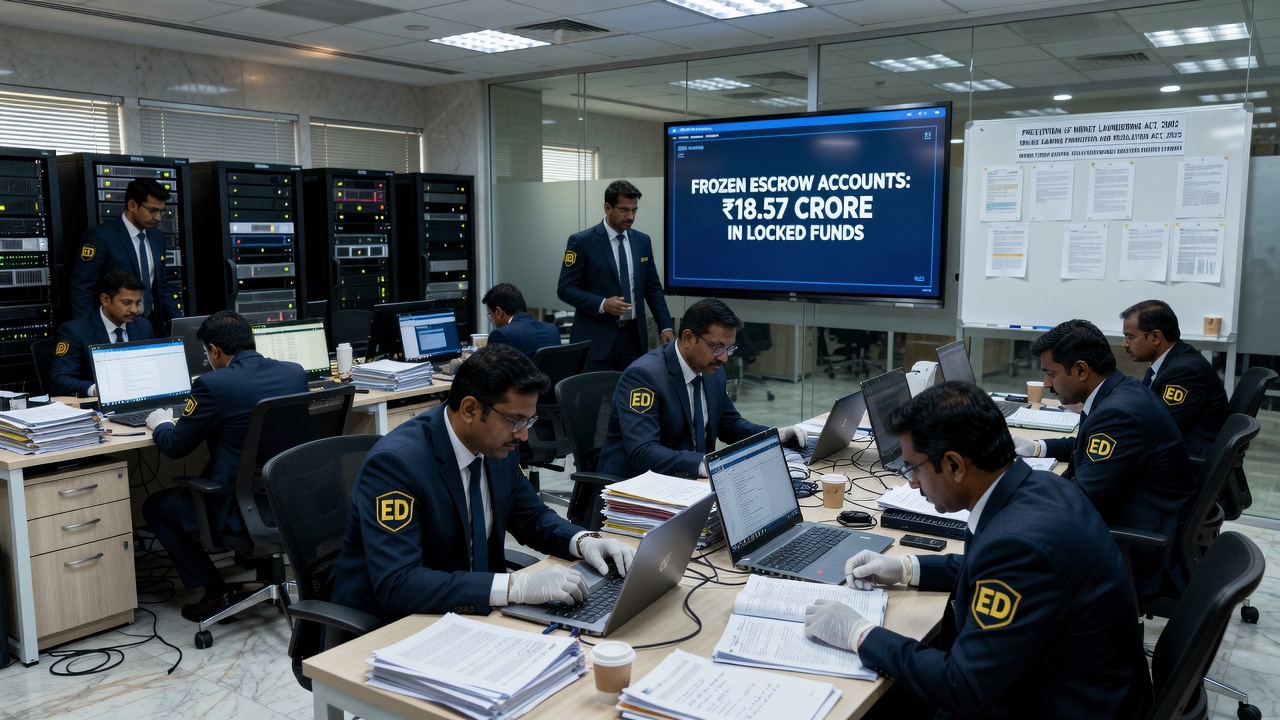
Enforcement Directorate officials fanned out across Delhi-NCR, Bengaluru and other cities on Thursday, May 7, executing search operations tied to an alleged online gaming and betting money-laundering case valued at roughly ₹1,000 crore. The raids, carried out by the agency's Bengaluru Zonal Office, targeted Gameskraft Technologies Pvt Ltd, its directors, and several individuals linked to the company's betting-related operations.
The case underscores how quickly regulatory scrutiny is intensifying around real-money gaming platforms operating in a market where the legal boundary between skill-based games and prohibited betting remains contested. As debates continue over what qualifies as legitimate wagering under Indian law, questions about the name of name of bet in india classifications and permissible formats have become central to how enforcement agencies interpret user complaints and platform conduct. This latest search operation is separate from an earlier ED action against Gameskraft-linked entities conducted last year, indicating the company remains under sustained investigative attention across multiple fronts.
Officials seized documents, digital records and electronic devices during the operation, material that will likely form the evidentiary backbone of the money-laundering probe now proceeding under the Prevention of Money Laundering Act. The FIRs originated with Bengaluru police before being escalated to the ED, a common pathway when local complaints reveal potential cross-border financial flows or organized fraud.
The Pocket52 Complaints That Triggered Scrutiny
Investigators trace part of this case back to searches conducted between November 18 and 22, 2025, at properties linked to Nirdesa Networks Pvt Ltd and Gameskraft Technologies. Those searches followed FIRs alleging large-scale fraud on Pocket52, a gaming platform operated by NNPL. Complainants alleged manipulated game outcomes, collusion among players, restricted withdrawals and an overall absence of transparency in how the platform functioned. One complainant reportedly claimed losses exceeding ₹3 crore, while others flagged concerns about algorithmic manipulation shaping game results in ways that disadvantaged ordinary users.
These allegations, if substantiated, point to a deeper structural problem in unregulated or loosely regulated online gaming: platforms controlling both the game engine and the payout mechanism create an inherent conflict of interest that is difficult for individual players to detect or challenge. Without independent auditing of random-number generators or game logic, users have limited means of verifying fairness, leaving them dependent on the operator's own claims of integrity.
Escrow Accounts and the PROG Act's Limits
A notable detail in the ED's findings concerns escrow accounts required under the Online Gaming Promotion and Regulation Act, 2025. Despite restrictions imposed by this framework, more than ₹30 crore reportedly remained locked in escrow rather than being returned to gamers and customers as intended. The ED has since frozen eight escrow accounts holding an estimated ₹18.57 crore, treating the funds as suspected proceeds of crime pending further investigation.
This detail matters beyond the specific case. Escrow mechanisms exist precisely to protect user funds from being commingled with operational revenue, giving regulators a way to ring-fence money owed to consumers. When such safeguards fail to function as designed, it raises broader questions about enforcement capacity and whether newer gaming legislation is being implemented with sufficient oversight infrastructure to match its stated intent.
What This Means for Platforms and Players
- Ongoing investigations reinforce that real-money gaming operators face rising compliance expectations, including transparent fund handling and verifiable game mechanics.
- Consumers engaging with betting or gaming platforms should treat withdrawal restrictions or unexplained account freezes as warning signs rather than routine friction.
- Regulatory frameworks like the PROG Act depend heavily on enforcement follow-through; legislation alone does not guarantee consumer protection.
The case remains under active investigation, and no findings of guilt have been established against Gameskraft or its directors at this stage. Its outcome will likely influence how aggressively Indian authorities pursue similar complaints against other online gaming operators in the months ahead.