
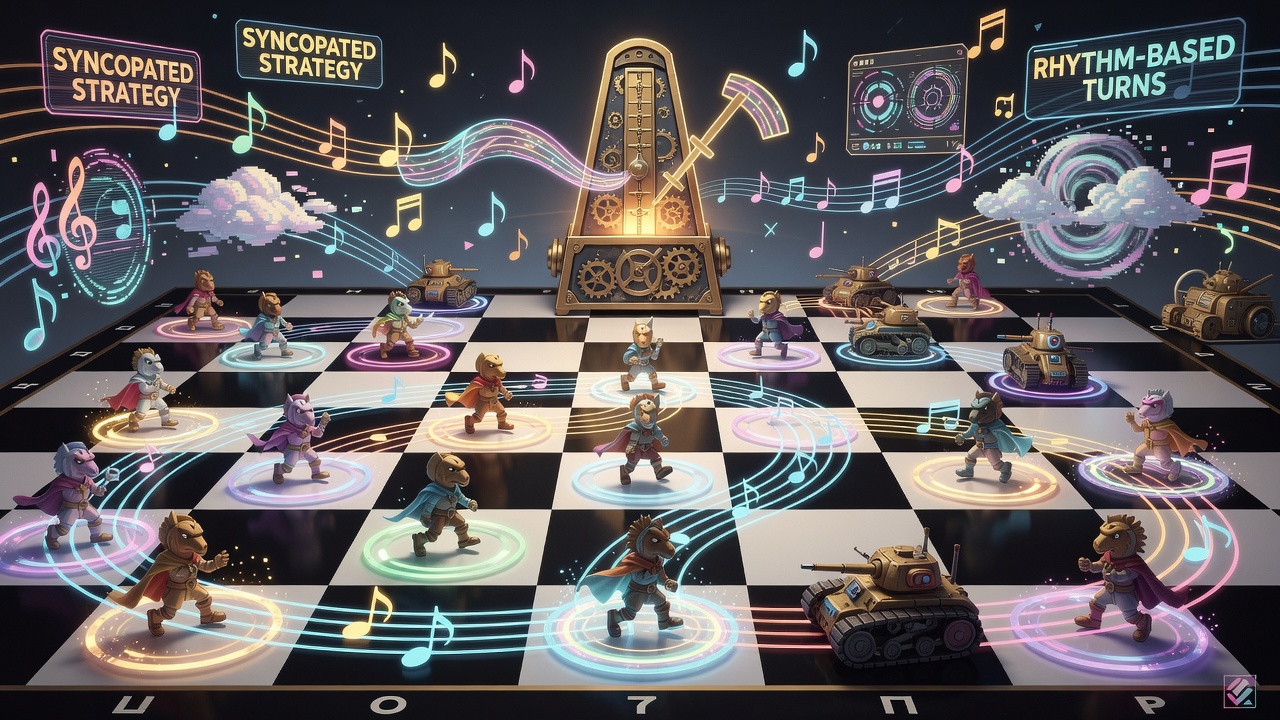
A chess clock ticking down is stressful. A metronome ticking down is something else entirely - it invites you to move with it, not against it. That distinction sits at the heart of a design trend that has quietly reshaped strategy gaming over the past decade: designers stopped treating time as a punishment and started treating it as an instrument. Instead of a bare countdown, players now encounter pulses, beats, and staggered windows that reward timing as much as tactics.
This shift matters because traditional turn order - you move, I move, repeat - feels increasingly flat next to systems where timing itself becomes a resource. Developers experimenting with funky time management have found that players engage more deeply when the clock has personality rather than just pressure. Some of these systems have even migrated into casual and browser-based titles; a promotional example like funky time strategy shows how playful timing hooks can carry over into lighter, faster formats without losing the tactical bite that strategy fans expect. The result is a genre-crossing conversation about what "turns" even mean anymore.
What follows is a close look at how these mechanics work, why they succeed where flat countdowns fail, and what they reveal about the future of tactical design. The goal is not nostalgia for classic strategy games, but a clear-eyed account of a mechanical evolution still very much in progress.
What Makes Time "Funky" in Strategy Games
The word "funky" sounds informal for a design discussion, but it captures something precise: irregularity with intention. A funky system doesn't just measure time - it bends it, syncopates it, or ties it to something unexpected, like music or momentum.
Defining Funky Time Management as a Design Category
Funky time management refers to any system where the passage or measurement of time departs from a strict, predictable countdown. Instead of a uniform clock, players face variable intervals, overlapping windows, or timing tied to in-game events rather than a wall clock. The defining trait isn't chaos - it's structured unpredictability that still rewards skill.
Why Traditional Countdown Timers Fall Short
Standard timers create anxiety without depth. Once a player learns the countdown's pace, the tension flattens into routine. Funky mechanics avoid this by shifting the rhythm itself, forcing players to keep re-reading the situation rather than memorizing a pattern.
The Psychological Appeal of Irregular Timing
Irregular timing keeps attention sharp because the brain can't fully automate its response. Cognitive research on vigilance consistently shows that unpredictable intervals sustain focus longer than fixed ones - a principle strategy designers have absorbed, whether or not they cite it directly.
Core Mechanics Behind Time-Based Strategy Games
Before examining rhythm specifically, it helps to separate the broader category of time-based strategy games from the funky subset. Not every time-driven system is playful - some are simply strict. Understanding the baseline clarifies what makes the funky variants distinct.
Real-Time vs. Turn-Based Foundations
Real-time strategy demands constant micro-decisions under a live clock, while turn-based strategy traditionally grants unlimited (or generously bounded) thinking time per turn. Time-based strategy games often sit between these poles, imposing soft deadlines on turns without collapsing into full real-time chaos.
Action Points, Cooldowns, and Timers
Many systems combine multiple timing layers: action points that regenerate on a schedule, cooldowns tied to specific abilities, and overarching round timers. Layering these clocks creates depth, because players must track several timing rhythms simultaneously rather than one.
How Time Pressure Alters Decision-Making
- Players default to simpler, faster heuristics under pressure, reducing analysis paralysis.
- Risk tolerance often rises as available time shrinks, leading to bolder plays.
- Memory of prior turns weakens under tight timing, making adaptability more valuable than long-term planning.
Rhythmic Strategy Mechanics Explained
Rhythm-based systems take funky timing a step further by tying gameplay directly to a beat or pulse. This is where strategy design borrows most openly from music.
Beat-Synced Actions and Combo Windows
Some titles require actions to land on or near a beat to gain bonus effects, echoing rhythm-game mechanics inside a tactical framework. Missing the beat doesn't always fail the action outright - it often just reduces its efficiency, which keeps the system forgiving enough for strategic depth to matter.
Musical Structure as a Turn Framework
Instead of "turn one, turn two," some systems organize play into measures or phrases, borrowing structure from musical composition. This gives players a mental model - verse, build, chorus - that feels more intuitive than an abstract numbered sequence.
Why Rhythm Improves Player Engagement
Rhythmic strategy mechanics succeed because rhythm is a pattern the human brain processes almost automatically. Once players internalize a beat, they can predict upcoming windows and plan several steps ahead, which paradoxically makes rhythm-based systems feel more strategic, not less, despite their playful surface.
Quirky Time Control Systems and Their Impact on Gameplay
Where rhythmic mechanics rely on a steady pulse, quirky time control leans into irregularity by design - clocks that speed up, reverse, or fork depending on choices made earlier.
Non-Linear and Reversible Time Mechanics
A handful of strategy titles let players rewind a limited number of turns or briefly pause the clock as a spendable resource. This transforms time from a fixed constraint into a tactical currency, changing how players value early-game decisions.
Asymmetric Timing Between Players or Units
Quirky time control often assigns different clock speeds to different units or factions - a slower, tankier unit might get more thinking time per action than a fast scout. This asymmetry forces players to plan around uneven information and uneven decision windows simultaneously.
Randomized or Event-Triggered Time Shifts
Some systems introduce sudden time distortions tied to in-game events: a storm that speeds up everyone's clock, or a triggered ability that freezes an opponent's turn briefly. These moments inject volatility that keeps late-game strategy from becoming predictable.
Funky Turn-Based Timing: Breaking the Traditional Turn Order
Turn order has long been treated as sacred in strategy design - you go, then I go. Funky turn-based timing challenges that assumption directly, often to striking effect.
Initiative Systems and Dynamic Turn Queues
Rather than strict alternation, initiative-based systems reorder turns based on unit speed, recent actions, or randomized rolls each round. This keeps players guessing about who acts next, which adds a layer of prediction on top of standard tactical planning.
Simultaneous Turns with Timed Reveals
Some games have all players commit moves privately within a set window, then reveal and resolve them together. This format rewards anticipation of an opponent's likely choice as much as raw tactical skill, blending bluffing with strategy.
Overlapping Turns and Shared Timing Windows
A newer approach allows two or more players' turns to overlap partially, so actions can interact mid-resolution rather than resolving in strict sequence. This creates tense moments where timing an action a fraction early or late changes the outcome entirely.
Designing and Balancing Funky Time Systems
Novelty alone doesn't sustain a game. Designers need to balance funky timing so it enhances strategy rather than replacing it with pure reaction speed.
Avoiding Frustration Without Sacrificing Tension
The line between exciting and punishing is thin. Successful systems build in small buffers - grace periods, partial success states - so players who miss a timing window by a fraction aren't wiped out entirely, preserving tension without tipping into frustration.
Balancing Skill Expression with Accessibility
Rhythmic and quirky timing systems risk alienating players who struggle with fast reactions. The strongest designs let skilled timing offer bonuses rather than mandatory requirements, so slower or more deliberate players can still compete through planning.
Playtesting Rhythmic and Irregular Timing
Because these systems depend heavily on human perception of time, they require extensive playtesting across different skill levels and reaction speeds. Designers often iterate on beat length or window size dozens of times before a rhythm feels intuitive rather than arbitrary.
The Future of Time-Based Strategy Design
Funky time management is no longer a niche experiment confined to indie curiosities. As tools for precise timing detection improve, larger studios are folding rhythmic and quirky elements into mainstream tactical titles.
Cross-Genre Influence from Rhythm and Music Games
Strategy design continues to borrow more from rhythm games - not full beat-matching, but structural cues like tempo changes and buildup phases that signal escalating stakes.
Adaptive Timing Powered by Player Behavior
Some emerging systems adjust timing windows dynamically based on a player's recent performance, tightening or loosening the clock to maintain consistent challenge rather than relying on a single fixed difficulty setting.
What Players Should Expect Next
Expect more hybrid formats blending funky turn-based timing with light real-time elements, along with deeper customization letting players choose how irregular they want their clock to feel.
Frequently Asked Questions
Why do some strategy games use irregular timing instead of a simple countdown?
Irregular timing keeps players mentally engaged because a predictable countdown eventually becomes routine. Designers use funky and rhythmic systems specifically to prevent players from settling into autopilot decision-making.
Do rhythmic strategy mechanics require musical skill to play well?
No. Most systems only require players to recognize a repeating pattern, not perform precise musical timing. Strategic planning around the rhythm matters far more than musical talent.
How do quirky time control systems avoid feeling unfair?
Well-designed systems build in buffers, partial rewards, or predictable rules governing when and how time shifts occur, so irregularity feels like a puzzle to solve rather than a random punishment.
What is the difference between funky turn-based timing and real-time strategy?
Real-time strategy runs on a continuous clock with no formal turn structure, while funky turn-based timing still preserves distinct turns or phases but manipulates their order, length, or overlap in unconventional ways.
Can slower, more deliberate players still succeed in games with quirky time control?
Yes, provided the system is balanced correctly. Many designs reward planning and pattern recognition as heavily as quick reactions, giving deliberate players a genuine path to victory alongside faster ones.
Is funky time management only found in niche or indie games?
It started largely in smaller experimental titles but has since spread into broader tactical and even casual formats, showing that playful, irregular timing appeals well beyond a narrow hobbyist audience.