
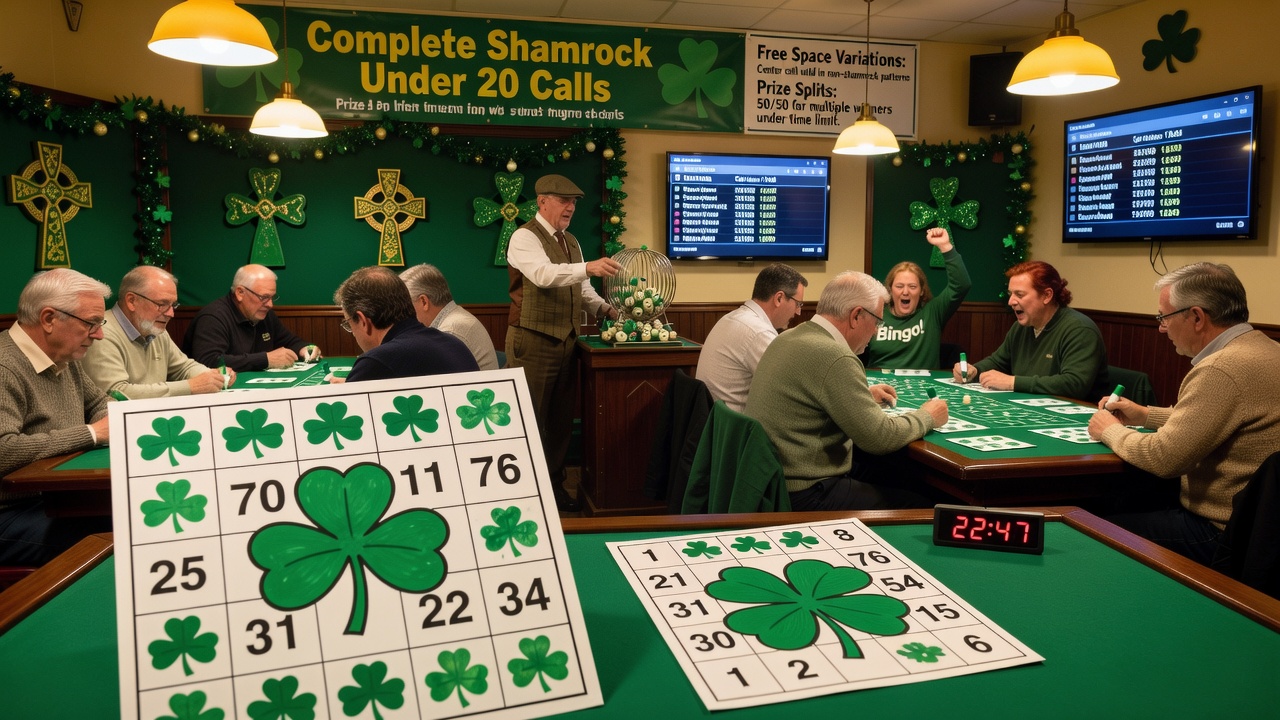
Seventy-five numbers, one shamrock-shaped pattern, and a card that looks nothing like traditional bingo - that's the short version of what separates Irish Bingo from the game your grandmother played at the parish hall. The name is a bit of a misnomer, too: Irish Bingo did not originate in Dublin or Cork, and most Irish pubs actually run standard 90-ball games. What's called "Irish Bingo" in most online and social settings is a specific pattern-based variant that rewards early pattern recognition over blind luck alone.
That distinction matters because the rules shift depending on where you play, and the difference between a winning card and a near-miss often comes down to knowing the pattern before the caller finishes the first ten numbers. For players learning how to play irish bingo for the first time, understanding the shamrock or four-leaf-clover layout is the single biggest hurdle - and the biggest advantage once cleared. If you want to see the mechanics in action before committing real stakes, a working demonstration of how to play irich bingo is available through platforms that host the variant live, which shortens the learning curve considerably.
This piece breaks down the actual mechanics, the card patterns that define the game, the house rules that change from operator to operator, and the strategic adjustments that separate casual players from consistent winners.
What Makes Irish Bingo Different From Traditional Bingo
Traditional 75-ball or 90-ball bingo asks players to complete a line, a full house, or a simple geometric shape. Irish Bingo, by contrast, is built around a themed pattern - most commonly a shamrock, a four-leaf clover, or a Celtic cross - printed directly onto the card layout. The numbers matter less than their position within that shape.
Origins and Modern Adaptation
The game likely emerged from American and British bingo halls looking for a themed variant to run around March, tied loosely to Saint Patrick's Day promotions. It stuck because the pattern requirement added a layer of skill-adjacent decision-making that flat bingo lacks. Over time, online operators adopted the format year-round, decoupling it from the holiday entirely.
Core Differences From Standard Formats
In standard bingo, any five-in-a-row or full-card completion wins. In Irish Bingo, only numbers falling within the designated shamrock cells count toward victory, even if you've marked every other number on the card. This changes how players track their cards - you're not scanning for lines, you're scanning for a shape.
How to Play Irish Bingo: Step-by-Step Basics
Learning how to play irish bingo starts with understanding that the core mechanics - number calling, marking, and win verification - remain identical to standard bingo. The difference is entirely in what you're marking toward.
Setting Up the Game
Each player receives a card printed with numbers arranged in a 5x5 or 9x3 grid, depending on whether the operator uses a 75-ball or 90-ball base. Superimposed on that grid is the shamrock or clover pattern - usually highlighted in green or outlined with bold borders so players can identify the target cells immediately.
Calling and Marking Numbers
A caller (live or automated in online formats) draws numbers at random. Players mark matches on their card as usual. The critical habit to build early is marking with the pattern in mind - glance at whether the called number sits inside your shamrock before marking it elsewhere on the card. This sounds trivial until you're playing four cards simultaneously.
Declaring a Win
A win is declared the moment every cell within the designated pattern is marked. In live settings, players call out "Bingo" or the house-specific term immediately, since delayed calls can be voided if another player completes their pattern first. Online platforms handle this automatically, but the underlying irish bingo rules for win validation remain the same across formats.
Understanding Irish Bingo Card Patterns
The pattern is the entire identity of the game, and irish bingo card patterns vary more than most players expect.
The Classic Shamrock Layout
The most common pattern uses three overlapping circular clusters arranged like a shamrock's leaves, with a stem extending toward the bottom of the card. Players need to complete all three leaf clusters plus the stem cells to win - a structure that typically requires marking twelve to sixteen numbers depending on card size.
Four-Leaf Clover Variant
Some operators run a four-leaf version instead, adding a fourth cluster for a symmetrical layout. This variant statistically takes longer to complete since it requires more marked cells, which affects both pacing and prize structuring - houses often raise the payout accordingly.
Corner and Cross Hybrids
Less common but worth knowing: some houses blend the shamrock with a standard cross pattern, letting players win via either the full shamrock or a simpler four-corner-plus-center configuration. This hybrid approach speeds up games and is popular in social or charity settings where turnover matters more than prize size.
Reading a Pattern Card Correctly
Before the first number is called, always confirm which cells count. Misreading the pattern is the single most common beginner error, and it usually shows up as a "false bingo" call that costs a round.
- Identify the outlined or shaded cells before play begins
- Count the total cells required to confirm the pattern's difficulty
- Check whether the stem or center cell is mandatory for a valid win
Irish Bingo House Rules You Need to Know
No two venues run the game identically, and irish bingo house rules can change the entire strategic approach.
Variations in Free Space Handling
Some houses treat the center cell as an automatic free mark; others require it to be earned by matching a called number. This single rule can shave several calls off the time needed to complete a pattern, so always confirm it before buying in.
Multiple Winner Splits
Because pattern-based games often produce simultaneous winners more frequently than line bingo, most houses split the prize pool evenly among all players who complete the shamrock in the same call. A few operators instead award the full prize to whoever calls first, verified by timestamp in online formats.
Speed Rounds and Progressive Jackpots
Larger venues and online rooms frequently layer progressive jackpots onto Irish Bingo, triggered when a player completes the pattern within a set number of calls - commonly under twenty. Speed rounds compress the calling interval, rewarding players who track patterns quickly rather than methodically.
Tips and Strategies for Irish Bingo
Because the win condition is shape-based rather than line-based, tips and strategies for irish bingo differ meaningfully from general bingo advice.
Prioritize Pattern Familiarity Over Card Volume
Playing more cards only helps if you can track each pattern accurately. A player managing two cards with full pattern awareness consistently outperforms one juggling six cards and missing marks. Start with fewer cards until pattern-scanning becomes automatic.
Track the Stem and Center First
In shamrock layouts, the stem and center cells are often the bottleneck - they're fewer in number but just as necessary as the leaf clusters. Mentally flag these cells as priority marks the moment they're called, since missing one late in the round is the most common way to lose a near-complete card.
Use Probability, Not Superstition
With 75 numbers in circulation, each cell has a roughly equal chance of being called at any point, so no cell "runs hot." What actually improves outcomes is choosing cards with well-distributed numbers across the pattern rather than clustered digit ranges, since clustering increases the odds of long dry stretches within your shamrock.
Adjust Pace to House Rules
If a venue runs speed rounds, slow deliberate scanning becomes a liability. Practice marking without pausing to double-check each cell - accuracy under time pressure is the deciding factor in fast-paced formats.
Frequently Asked Questions
Is Irish Bingo actually played in Ireland?
Not typically under that name. Most bingo halls in Ireland run standard 90-ball games. "Irish Bingo" as a pattern-based shamrock variant is largely a product of American and online bingo culture, often tied to Saint Patrick's Day themes.
Do I need a special card to play, or can I use a regular bingo card?
You need a card with the shamrock or clover pattern printed or highlighted on it. A standard bingo card without that overlay won't work, since the win condition depends entirely on which cells are designated as part of the pattern.
How many numbers usually need to be marked to win?
It depends on the specific pattern and card size, but most shamrock layouts require somewhere between twelve and sixteen marked cells. Four-leaf variants typically require a few more, which is why houses often adjust prize sizes accordingly.
Can I play Irish Bingo online, or is it only offered in physical venues?
It's widely available online through bingo platforms that offer themed variants alongside standard 75-ball and 90-ball games. Online versions automate win verification, which removes the risk of missing a call during fast-paced rounds.
What happens if two players complete the pattern on the same number?
Most houses split the prize evenly between simultaneous winners, though this depends entirely on local house rules. Some operators instead use timestamp verification in online formats to determine a single winner, so it's worth checking the rules before a session starts.
Is there a real skill element, or is it pure chance like regular bingo?
The number draw itself is entirely random, but pattern recognition and marking accuracy are skill-based components that genuinely affect outcomes. Players who track the pattern's specific cells efficiently, especially under speed-round conditions, win more consistently than those who scan the entire card indiscriminately.