
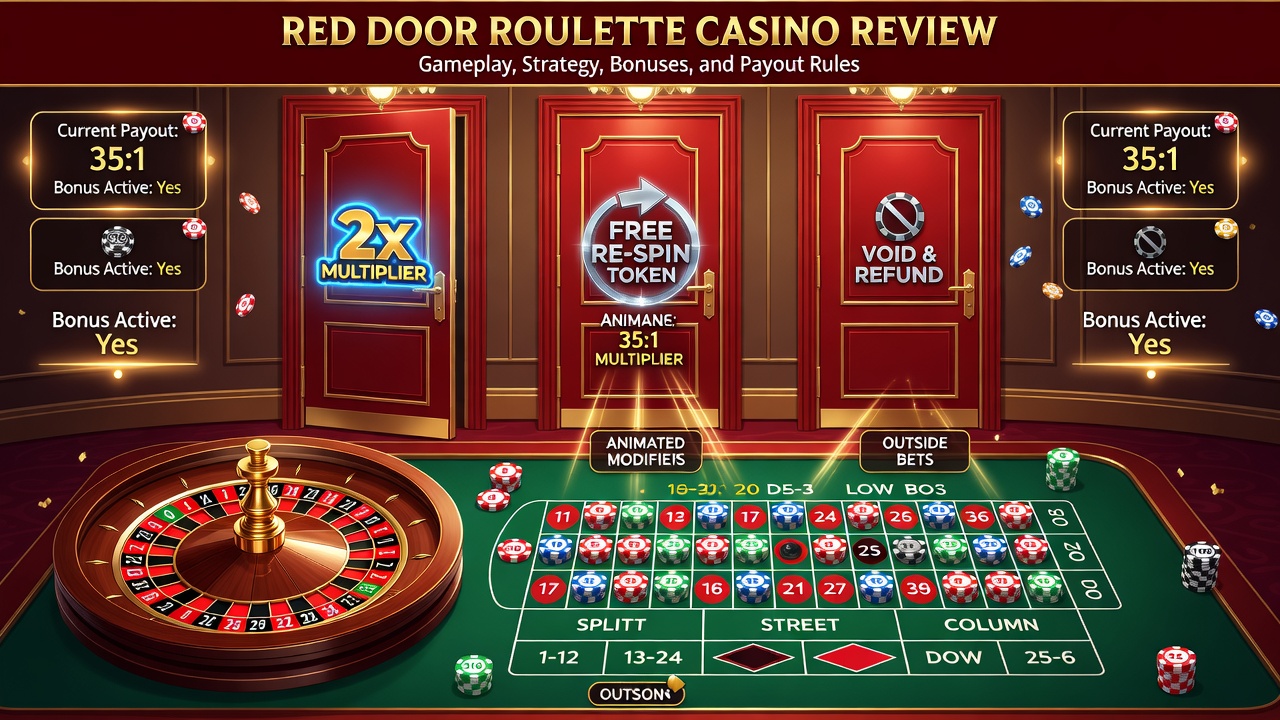
Three red doors, one wheel, and a payout structure that rewards patience over impulse - that's the pitch behind a roulette variant that has quietly built a following among players tired of the standard European or American layout. Red Door Roulette borrows the mechanics of classic roulette but wraps them in a bonus-triggering mini-game that changes how you think about betting decisions from the first spin.
What makes this variant worth a closer look isn't novelty for its own sake. The door mechanic actually shifts the math of the game in ways that reward specific betting patterns over others, and that's rare in a genre where most "innovations" are cosmetic skins on the same 37 or 38 pockets. Before committing real bankroll to any session, it's worth reading a full more details breakdown of how the doors interact with the wheel outcomes, since the bonus round timing directly affects optimal betting cycles. Understanding that interaction early saves you from misreading the game as a simple reskin.
This piece works through the mechanics, the realistic strategic options, the bonus structures operators typically attach to this title, and the payout rules that determine whether a session is mathematically sound or a slow bleed. Readers who want a straight, no-hype accounting of how the game actually performs will find the detail here.
What Is Red Door Roulette? Understanding the Game Concept
Red Door Roulette takes the familiar wheel-and-ball format and layers a secondary feature on top: three doors, each capable of triggering a bonus outcome - a multiplier, a free spin, or an altered payout on the current bet - depending on where the ball lands and which door subsequently "activates." The base game still functions as recognizable roulette. Numbers 0 through 36 (or 0 and 00 in the American-style build some operators offer), red and black pockets, even/odd, and the standard inside/outside betting grid all remain intact.
The door layer is what separates a red door roulette casino review from a review of ordinary roulette. It's not just an aesthetic gimmick; it changes the expected value calculation for certain bets during specific rounds.
Origins and Table Design
The format draws on a wave of roulette variants developed for online casinos looking to differentiate a saturated table-games category. Rather than reinventing the wheel itself, developers added a feature layer - in this case, three doors positioned above or beside the wheel display, each corresponding to a randomized bonus condition revealed after the ball settles.
How It Differs From Classic Roulette
Classic roulette is a fixed-odds game with no secondary mechanics. Red Door Roulette introduces variable bonus multipliers that can apply to a portion of your bet, meaning two players placing identical wagers on the same spin can walk away with different returns if one benefits from a door activation and the other doesn't.
- Standard wheel with 37 or 38 pockets depending on the build
- Three bonus doors revealed after ball placement
- Door outcomes can multiply, refund, or extend a bet
- Base betting grid identical to traditional roulette tables
Red Door Roulette Gameplay: Mechanics and Round Structure
Every round follows a familiar rhythm: place bets, watch the wheel spin, wait for the ball to settle. What happens next is where red door roulette gameplay diverges. Once the winning number is locked in, the game triggers the door reveal sequence - one, two, or occasionally all three doors open, each disclosing a modifier that applies to eligible bets from that round.
The Betting Phase
Players place chips on the standard grid - straight-up numbers, splits, streets, corners, columns, dozens, or the outside bets like red/black and high/low. Betting windows typically run 15 to 20 seconds, consistent with most live and RNG-based roulette tables. Nothing about this phase differs from traditional roulette, which keeps the learning curve low for players transitioning from standard tables.
The Door Reveal Sequence
After the spin resolves, the doors animate open in sequence. A door might reveal a 2x multiplier applied to outside bets, a free re-spin token, or occasionally a "void and refund" condition that returns a losing bet to the player. The specific modifiers vary by operator and build, but the underlying principle stays consistent: the door phase is a secondary randomization layer stacked on top of the primary wheel outcome.
Round Pacing and Table Speed
Because of the added reveal animation, full rounds run slightly longer than standard roulette - often adding five to ten seconds per spin. This matters for players tracking hourly bet volume, since a slower table means fewer rounds per session and, by extension, a different exposure curve to variance.
Red Door Roulette Strategy: What Actually Works
Strategy conversations around roulette variants tend to overpromise. No door mechanic changes the fact that roulette remains a negative-expectation game over the long run. That said, the door layer does create situational opportunities that a disciplined player can exploit better than a careless one.
Betting Systems and Their Limits
Progressive systems like Martingale or Fibonacci get applied to Red Door Roulette the same way they get applied to standard tables, and they carry the same structural weakness: they manage bet sizing, not house edge. The door bonuses don't fix this. If anything, a multiplier landing on a losing streak can tempt players into escalating bets past their bankroll limits, which is a documented risk pattern in bonus-layered games generally.
Bankroll Allocation Across Sessions
A sound red door roulette strategy starts with session budgeting, not bet selection. Because door activations are unpredictable and don't correlate with previous outcomes, treating each spin as an independent event - and sizing bets as a fixed percentage of a session bankroll rather than a fixed dollar amount - keeps variance manageable.
Outside Bets vs. Inside Bets in a Door-Modified Game
Outside bets (red/black, odd/even, high/low) carry lower variance and are more frequently the target of door multipliers in most builds, since operators tend to cap bonus eligibility to keep payout ratios controlled. Players focused on longevity over big single-hit wins often favor these bets specifically because door bonuses compound more predictably on lower-variance wagers.
- Prioritize outside bets when door multipliers apply broadly
- Avoid chasing losses after a door bonus fails to trigger
- Track session length against bankroll depletion rate, not just win/loss count
Red Door Roulette Bonus Structures and Promotions
Operators offering this title typically wrap it into broader casino promotions rather than issuing game-exclusive incentives, though some platforms do run dedicated red door roulette bonus campaigns tied to the door mechanic itself - for instance, a promotional period where door activation rates are marketed as elevated, or where wagering on the title contributes fully toward a welcome bonus rollover.
Welcome Bonuses and Table Game Eligibility
Not all welcome bonuses apply equally to table games. Many operators restrict roulette variants to a fraction of wagering contribution - commonly 10% to 20% - compared to slots, which often count at 100%. Anyone planning to clear a bonus primarily through Red Door Roulette needs to check contribution rates before assuming a deposit match translates into usable roulette bankroll.
In-Game Bonus Mechanics vs. Casino-Level Promotions
It's worth distinguishing the door-triggered bonuses built into the game itself from casino-level promotions like deposit matches or free-bet credits. The former is a gameplay feature; the latter is a marketing tool. Confusing the two leads players to overestimate how "generous" a session might be, when in reality the door mechanic is simply variance redistribution, not free value.
Loyalty Programs and Recurring Play Incentives
Some platforms tier their loyalty rewards to include cashback or comp points specifically for table-game wagering, which benefits regular Red Door Roulette players over sporadic ones. Reading the fine print on point accrual rates for roulette versus slots is worthwhile, since the ratios frequently differ.
Red Door Roulette Payout Rules Explained
Payout structure is the section where players most often make costly assumptions. Base payouts follow standard roulette conventions - a straight-up number pays 35 to 1, a split pays 17 to 1, a column or dozen pays 2 to 1, and even-money outside bets pay 1 to 1. The door mechanic modifies these figures only when a bonus condition activates, and only for bets specified as eligible under that particular door's rules.
Standard Payout Table
- Straight-up (single number): 35 to 1
- Split (two numbers): 17 to 1
- Street (three numbers): 11 to 1
- Corner (four numbers): 8 to 1
- Column or dozen: 2 to 1
- Red/black, odd/even, high/low: 1 to 1
How Door Multipliers Alter Returns
When a door reveal produces a multiplier - say, 2x or 3x - it applies only to the specific bet category flagged eligible for that round, not to the entire wager slate. A player with chips split across straight-up numbers and outside bets might see only the outside portion boosted, depending on which door activates and what condition it carries.
House Edge Considerations
Because the door layer is a redistribution mechanic rather than an added-value mechanic, the underlying house edge on Red Door Roulette tends to sit close to standard roulette figures - around 2.7% on European-style single-zero builds and closer to 5.26% on American-style double-zero versions. The bonus doors don't meaningfully shift this long-run figure; they shift short-term variance instead.
Red Door Roulette Casino Review: Platform Quality and Player Experience
Evaluating where to play this variant matters as much as understanding the mechanics themselves. Table speed, interface clarity, and the transparency of door-activation odds all affect whether a session feels fair and enjoyable or opaque and frustrating.
Interface and Visual Clarity
Well-built versions of this title display door outcomes with clear animation and an accompanying text explanation of what modifier applied and to which bets. Poorly built versions bury this information in small print or fast animations that make it hard to verify payouts match the displayed bonus condition.
RNG Certification and Fairness Auditing
Legitimate platforms offering Red Door Roulette typically hold RNG certification from independent testing labs, the same standard applied to conventional online roulette. Checking for this certification - usually disclosed in the platform's help section or licensing footer - is a reasonable first step before depositing.
Customer Support and Dispute Resolution
Because the door mechanic introduces an extra layer of calculation into each payout, disputes over whether a bonus applied correctly are more likely than on standard roulette tables. Platforms with responsive, roulette-literate support staff handle these disputes faster and more transparently than generalist support teams unfamiliar with the game's specific rules.
Frequently Asked Questions
Is Red Door Roulette better odds than standard roulette?
No. The house edge remains close to standard European or American roulette depending on the wheel format used. The door bonuses redistribute variance across bets rather than lowering the house edge itself.
Can I use a Martingale system with the door bonuses?
You can, but the door mechanic doesn't correct the fundamental weakness of progressive betting systems, which is exponential bet growth during losing streaks. Treat door bonuses as unpredictable variance, not as a reason to escalate wager size.
Do all casino bonuses apply fully to Red Door Roulette wagers?
Rarely. Most operators cap table-game contribution toward bonus wagering requirements at a fraction of the slot contribution rate, commonly between 10% and 20%. Always check the specific bonus terms before assuming full eligibility.
How often do the doors actually activate a bonus?
Activation frequency varies by platform and build, and operators don't always publish exact rates. Treat any door activation as a bonus layer on top of standard roulette outcomes rather than a guaranteed or frequent event.
Is this game available in live-dealer format?
Some platforms offer a live-dealer version alongside the RNG-based table, though availability depends on the specific casino's software partnerships. The door mechanic functions identically in both formats, though live tables typically run at a slower pace.
What's the safest way to try this variant for the first time?
Start with a demo or low-stakes table to observe how door activations behave across several dozen spins before committing meaningful bankroll. This lets you confirm payout accuracy and get comfortable with the pacing before real-money sessions.