
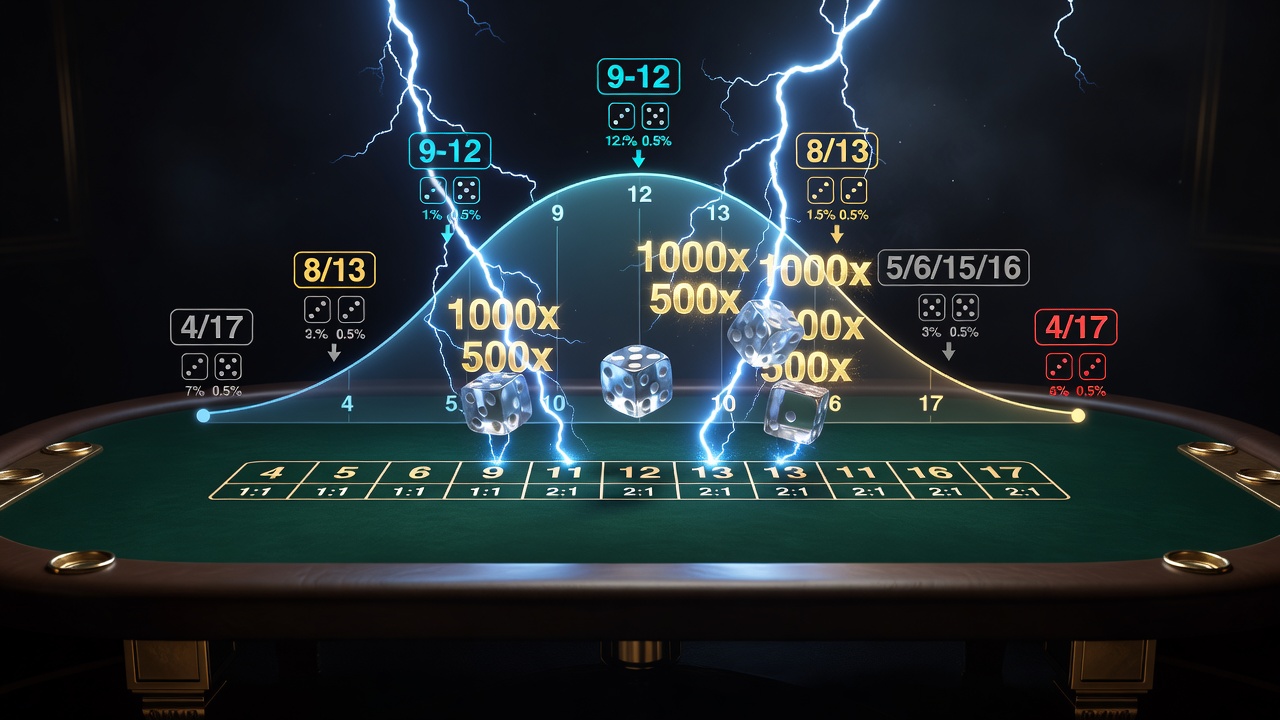
Three dice, a multiplier field capped at 1000x, and a single lightning strike that can turn a modest wager into a payout most players never see twice in a session. That is the entire mechanical premise of Lightning Dice, yet the game generates far more strategic conversation than its simplicity suggests. Numbers 4 through 17 sit on the board, each carrying its own payout, and beneath that board runs a probability structure that rewards players who understand it and punishes those who bet on instinct alone.
The appeal isn't mystery - it's math wearing a costume. Every roll draws from a fixed distribution, and once you know where the weight of that distribution sits, betting stops being guesswork. Some numbers land far more often than others, some payouts look tempting but carry brutal odds, and the lightning multipliers add a layer of volatility that changes how a rational player should size their stakes. Readers looking for a lightning dice strategy will find that the sharpest approach blends bet placement, bankroll discipline, and a realistic read of how often the electrified numbers actually strike.
What follows is a structural breakdown of how the game behaves, which combinations experienced players gravitate toward, and how to build a betting approach around the numbers rather than around hope.
Understanding the Basics of Lightning Dice
Before any lightning dice build makes sense, the underlying mechanics need to be clear. Three six-sided dice are rolled, and their sum - ranging from 3 to 18 - determines the outcome. Bets are placed on specific sums before the roll, and each sum carries a fixed payout multiplier that reflects how rare or common that total is. After bets close, a random number generator or live dealer triggers the roll, and one to three numbers on the board are struck by "lightning," which multiplies the payout for any bet placed on that number.
How the Dice and Multipliers Work Together
The dice determine the winning number; the lightning determines how much that number pays beyond its base rate. These are two separate randomization layers. A player can correctly predict the sum and still walk away with only the base payout if lightning never touches that number during the round. Conversely, a rarely-hit combination that gets struck by lightning can produce a payout that dwarfs anything a base multiplier offers.
Reading the Betting Board
The board lists every possible sum from 3 to 18, though 3 and 18 are often excluded from active betting in most versions since they require all three dice to show identical extreme values. Each number's base payout is inversely tied to its statistical frequency - numbers near the middle of the range pay less because they occur more often, while extreme numbers pay more because they are rare.
Why This Format Differs From Standard Dice Games
Unlike craps or sic bo, Lightning Dice strips away most side bets and focuses entirely on sum prediction plus the multiplier mechanic. That narrower focus is exactly what makes probability analysis so central to forming any coherent approach - there are fewer variables, but each one matters more.
Core Lightning Dice Combos Worth Knowing
Combos in this context refer to the specific dice combinations that produce each sum, and understanding how many combinations feed into a given number is the foundation of every serious lightning dice strategy guide.
High-Frequency Combos
The number 10 or 11 can be formed by the largest number of three-dice combinations, making them statistically the most likely outcomes on any given roll. Because so many different dice arrangements produce these middle sums, they carry the lowest payout multipliers but also the highest hit frequency.
Low-Frequency, High-Payout Combos
Sums like 5 or 16 are produced by far fewer dice combinations, which pushes their payout multipliers considerably higher. These are the numbers that create the dramatic wins players remember, precisely because so few dice arrangements can produce them.
Combo Clustering Around the Median
A useful mental model is picturing a bell curve centered around 10 and 11. Sums closer to that center have more combinational paths and thus higher probability; sums farther out taper off sharply. This clustering effect is why disciplined players spread bets across a cluster of mid-range numbers rather than concentrating everything on one extreme outlier.
- Sums of 10 and 11: highest combination count, lowest payout
- Sums of 8, 9, 12, 13: moderate combination count, moderate payout
- Sums of 5, 6, 15, 16: low combination count, high payout
- Sums of 4 and 17: very low combination count, very high payout
Lightning Dice Probability Odds Explained
Every payout multiplier on the board is set in relation to the true mathematical odds of that sum appearing, adjusted downward slightly to preserve the house edge. Understanding lightning dice probability odds means recognizing that payout size and actual frequency are inversely related by design, not by accident.
Calculating Base Probabilities
With three six-sided dice, there are 216 total possible combinations. The sum of 10 or 11 each account for roughly 27 of those combinations, giving them the highest individual probability of any single sum. By contrast, sums of 4 or 17 are produced by only three combinations each, making them dramatically rarer.
How the House Edge Is Built Into Payouts
If payouts matched true odds exactly, the game would have no built-in advantage for the operator. Instead, every multiplier is trimmed slightly below the mathematically "fair" value, which is standard across nearly all dice and roulette-style games. The gap between fair odds and offered payout is where the house edge lives.
The Role of Lightning Strikes in Shifting Expected Value
Lightning strikes are randomly assigned to one, two, or three numbers each round, and they temporarily boost the payout multiplier on struck numbers - sometimes dramatically. Because the strikes are random and not tied to the dice outcome, they add variance without changing the base probability of any sum appearing. This is a subtle but important distinction: the dice odds stay fixed, but the potential reward on any given round fluctuates with the lightning.
Best Rolls to Target for Maximum Value
Identifying lightning dice best rolls requires balancing three factors: base probability, payout size, and how often lightning historically seems to favor certain sections of the board across many rounds.
Balanced Rolls for Steady Play
Betting on 9, 10, 11, and 12 together captures the highest-probability zone of the board. Payouts here are modest, but the frequency of hits keeps bankroll erosion slow, which suits players prioritizing session length over big single wins.
High-Variance Rolls for Big Multiplier Chases
Targeting 5, 6, 15, or 16 sacrifices consistency for payout size. These rolls hit less often, but when a lightning strike lands on one of them, the resulting multiplier can turn a small bet into a substantial return. This approach fits players comfortable with longer losing stretches in exchange for occasional outsized wins.
Extreme Rolls: 4 and 17
Betting directly on 4 or 17 is the highest-risk, highest-reward path available. These sums appear so rarely that most sessions will pass without a single hit, but the payout multiplier - especially when boosted by lightning - is the largest on the board. This should represent a small fraction of any total wager, never the core of a strategy.
Building a Winning Lightning Dice Build
A lightning dice build refers to the overall betting configuration a player commits to across a session - which numbers get covered, how stakes are distributed, and how that allocation adjusts as the session unfolds.
Spreading Bets Across Probability Zones
An effective build usually blends a core position in the high-frequency middle numbers with smaller satellite bets on one or two higher-payout outliers. This structure keeps the bankroll active on most rolls while leaving room for a large multiplier hit to meaningfully boost the session total.
Bankroll Allocation Across a Session
A common framework allocates the majority of a session bankroll - often 60 to 70 percent - to the balanced middle-range numbers, reserving the remainder for higher-variance bets. This ratio can shift based on individual risk tolerance, but abandoning the middle entirely tends to produce erratic, short-lived sessions.
Adjusting the Build Based on Session Flow
Some players tighten their spread after a lightning-boosted win, banking the profit and returning to conservative middle bets. Others loosen their spread after a losing streak, chasing higher payouts to recover faster - a riskier approach that requires strict stop-loss discipline to avoid compounding losses.
Advanced Strategy Guide for Consistent Results
Moving from casual play to a structured lightning dice strategy guide means treating each session as a series of calculated decisions rather than isolated bets.
Setting Win and Loss Limits Before Playing
Deciding in advance how much profit triggers a stop, and how much loss triggers an exit, removes emotional decision-making from the equation. This single habit separates disciplined players from those who give back their gains chasing one more lightning strike.
Tracking Patterns Without Overreacting to Them
Dice rolls are independent events, so no streak of any single number predicts the next outcome. That said, tracking recent results over a session can help a player recognize when they've drifted from their planned build and pull back toward it.
Where to Find Deeper Strategic Breakdowns
Players wanting a more granular walkthrough of bet sizing, multiplier timing, and session structuring can consult a dedicated lightning dice strategy resource that expands on these principles with worked examples. Pairing that kind of reference material with the probability fundamentals covered here gives a fuller picture than either resource alone.
Recognizing When a Session Isn't Working
If a chosen build produces consistent losses across a reasonable sample of rolls - typically 30 or more - it's worth reassessing the spread rather than assuming the next roll will correct the trend. Rigid adherence to a failing build is a common and avoidable mistake.
Frequently Asked Questions
Is Lightning Dice purely luck, or does strategy actually matter?
The dice outcomes themselves are entirely random and unaffected by strategy. What strategy controls is bet distribution, bankroll longevity, and how effectively a player captures value when lightning strikes favorable numbers.
What is the safest number to bet on consistently?
Ten and eleven carry the highest hit frequency of any sum on the board, making them the most consistent choices for players prioritizing steady, lower-variance play over large payouts.
How often does lightning actually strike a number I've bet on?
Lightning strikes one to three numbers per round out of the available board, so the odds of a struck number matching your bet depend on how many numbers you've covered. Spreading bets across more numbers increases the chance of catching a strike, though it also reduces the stake on any single number.
Should I chase the 4 and 17 payouts for big wins?
Occasional small bets on these extreme sums can add excitement and occasional large payouts, but they shouldn't form the core of a session's budget. Their rarity means long stretches without a hit are the norm, not the exception.
How much of my bankroll should go into a single session?
A common guideline caps a single session at a small, predefined percentage of total bankroll - often 5 to 10 percent - to survive losing streaks without depleting funds needed for future play.
Does the house edge change based on which numbers I bet?
The house edge is built into every payout multiplier and stays relatively consistent across the board by design, though minor variations can exist depending on the specific numbers chosen and how payouts are rounded.