
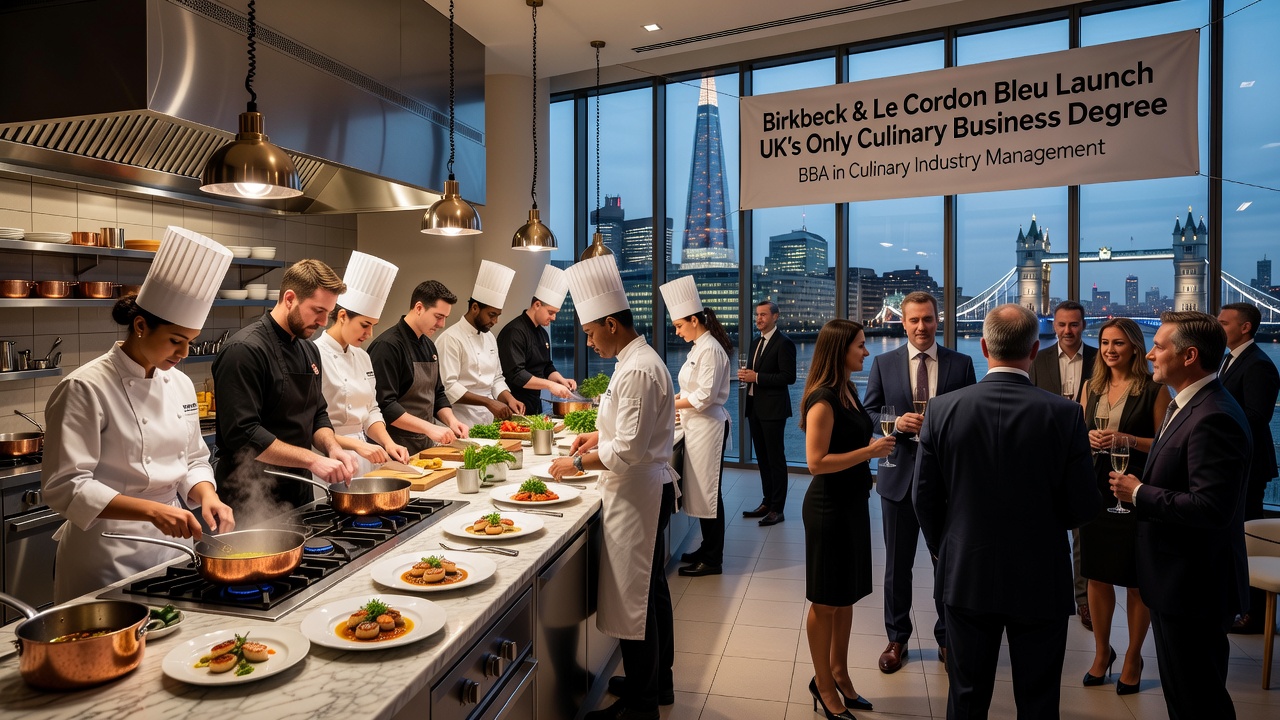
A new academic partnership is putting management theory and professional cookery on the same timetable. The BBA in Culinary Industry Management, delivered jointly by Birkbeck, University of London, and Le Cordon Bleu Culinary Arts Institute, is described as the only degree of its kind in the UK. It sits at the intersection of two fields that rarely share a classroom: formal business education and classical culinary training.
Why a hybrid degree matters for the hospitality sector
The hospitality and food service industry has long faced a structural gap between talented kitchen staff and the commercial skills needed to run a food business. Chefs are frequently promoted into management roles without formal training in finance, operations or people leadership. This course addresses that gap directly, combining culinary technique with modules in business and management taught through Birkbeck's established academic framework. Students split their week between the two institutions, which are located close enough in London to allow movement between sites within a single evening.
The structure reflects how the industry actually works. Culinary modules at Le Cordon Bleu are taught through demonstrations, workshops and practical sessions, while Birkbeck's business modules follow a more conventional lecture and seminar format. Evening teaching, running from 6.30pm to 9.30pm at Le Cordon Bleu, is designed around students who may be balancing study with existing employment, though the course is structured as full-time overall.
Industry links and the internship model
A defining feature of the course is the built-in internship between the first and second years, placed with employers that include well-known names in London hospitality such as the Savoy, Corinthia London, the Wolseley Hospitality Group and Hyatt Hotels. This is a meaningful element for a sector where practical placement and employer exposure often determine early career trajectories more than classroom grades alone. It also signals how the course is positioned: not purely academic, but tied closely to operational experience in professional kitchens and hotel management structures.
- Full-time route: three years, with UCAS tariff requirements of 96-112 points
- Foundation Year route: four years total, for those without standard qualifications or returning to study after a break
- Assessment combines practical culinary examinations with coursework, presentations and a final research project
- Free membership of the Institute of Hospitality is available to enrolled students
Access, entry routes and realistic expectations
The course's entry requirements are notably flexible. Birkbeck states it will consider applicants without traditional qualifications, basing decisions on prior experience and academic potential rather than exam results alone. The Foundation Year option exists specifically for people returning to education after time away, or who did not meet standard entry grades. This matters in a sector where career changers and mature students are common, and where rigid academic gatekeeping can exclude people with genuine industry aptitude.
International applicants should note that visa category depends on course length, and that students on a Student visa must study full-time and on campus, a requirement increasingly enforced across UK higher education as institutions tighten compliance with visa sponsorship rules. English language requirements follow standard UK university benchmarks, with IELTS 6.5 as the typical threshold.
What the course ultimately offers is not a shortcut into hospitality leadership, but a structured pathway combining two distinct forms of expertise. Its value will depend, as with any vocational-academic hybrid, on how well graduates translate dual training into roles that actually require both skill sets.