
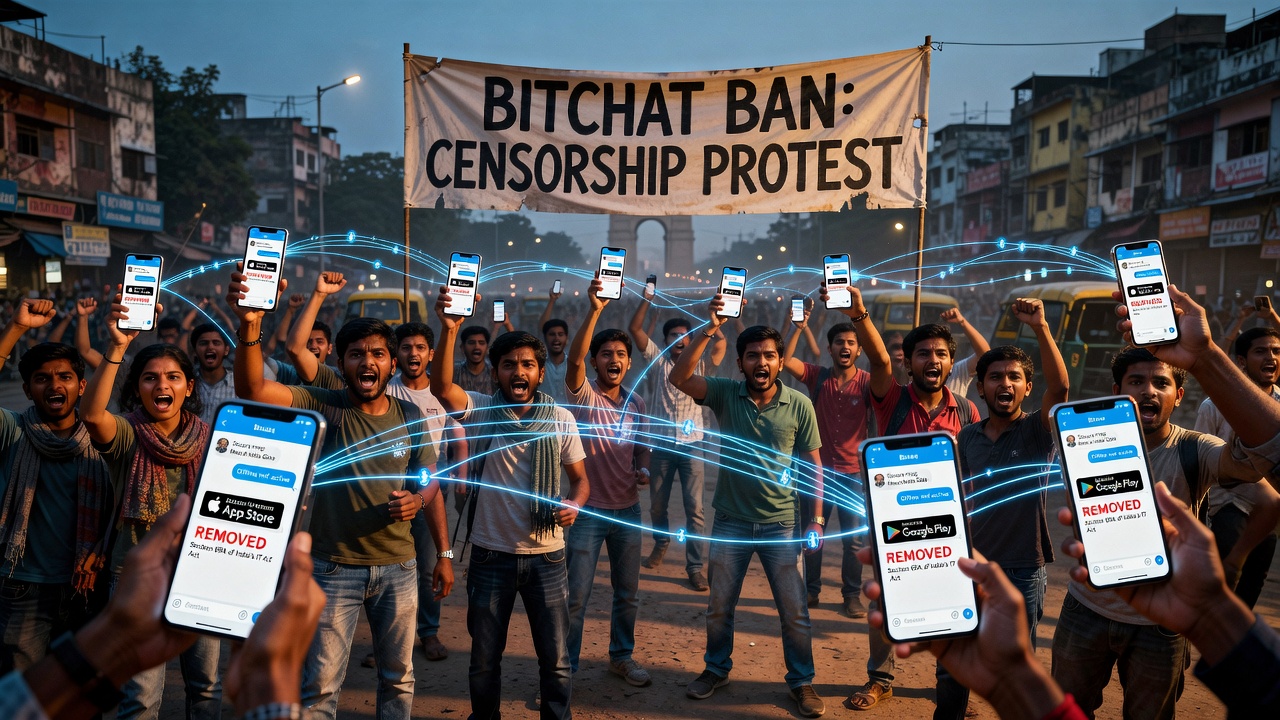
An encrypted messaging app that needs no internet connection has itself become unreachable in India. Bitchat, built by former Twitter chief Jack Dorsey, vanished from Apple's App Store and Google Play in the country this weekend, following a government order citing Section 69A of India's Information Technology Act - the same legal provision New Delhi has used for years to block websites and apps deemed threats to public order or national security.
What makes Bitchat different
Bitchat does not route messages through cell towers or data networks. Instead, it uses Bluetooth mesh networking, letting nearby phones relay encrypted messages directly to one another, hopping from device to device until a message reaches its destination. No server sits in the middle. No telecom operator carries the traffic. That design, open-sourced on GitHub, makes the app resilient to the kind of internet shutdowns Indian authorities have repeatedly imposed during periods of unrest.
It is precisely that resilience that appears to have drawn regulatory attention. The government's order to GitHub in July, issued under a different provision covering intermediary liability, argued that Bitchat's architecture made it difficult for law enforcement to intercept communications or identify users. The latest order against Apple relies on a separate legal basis, suggesting authorities are testing multiple regulatory levers against the same piece of software.
A legal basis that digital rights groups dispute
The Internet Freedom Foundation, a prominent digital rights group based in New Delhi, has called the new blocking order unconstitutional. Its argument is narrow but significant: Section 69A permits the government to block specific unlawful content, not an entire application because of what it is technically capable of doing. The group also noted that neither the blocking order itself nor any underlying illegal content has been made public - a transparency gap that has dogged India's content-blocking regime for years, since orders issued under this provision are typically confidential by default.
This matters beyond Bitchat. If a messaging platform can be removed from app stores purely because its architecture resists surveillance, the precedent extends to any encrypted or decentralized communication tool, including ones with far larger user bases.
Timing tied to street protests
The restrictions land as India faces renewed youth-led protests over alleged manipulation of voter rolls, with demonstrators in New Delhi demanding the chief election commissioner's resignation. Authorities suspended internet access around a central protest site for twelve hours on Friday - a now-familiar tactic during periods of unrest. During similar shutdowns in July, protesters turned to Bitchat and a rival app, Briar, to keep communicating offline. Download data from Sensor Tower showed Indian users accounted for roughly 85% of Bitchat's global downloads in the week those protests peaked, a sharp jump from near-negligible interest the month before.
What this signals for platforms and users
For Apple and Google, the episode illustrates the bind app-store operators face when governments issue removal orders: comply or risk losing market access entirely. Apple's notice confirmed Bitchat remains available outside India, including through its beta-testing channel, underscoring that this is a geographically targeted restriction rather than a global takedown.
For users, the broader lesson concerns the fragility of access to decentralized tools precisely when they are most needed - during shutdowns or periods of state scrutiny. For regulators, the case raises an unresolved question that extends well beyond India: how existing internet-blocking laws, often written for websites and static content, should apply to software whose core feature is operating independently of centralized infrastructure.