
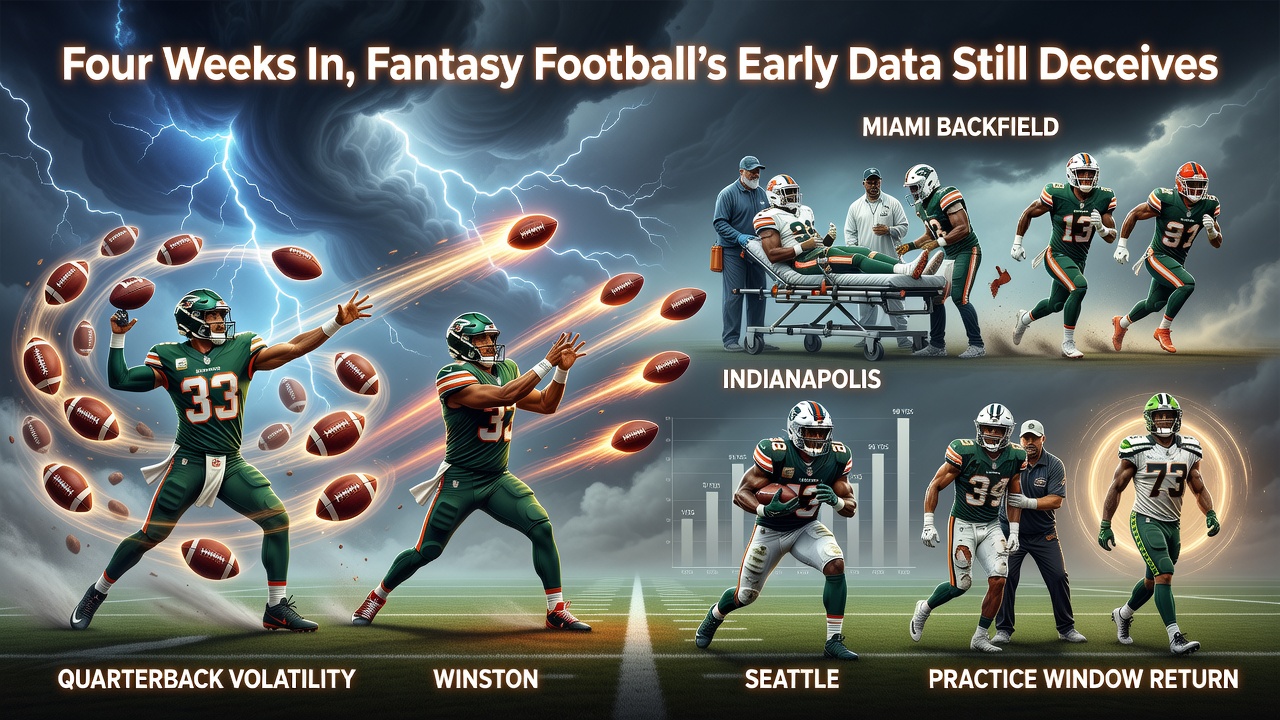
A quarter of the NFL season is complete, and the fantasy football landscape looks nothing like preseason projections suggested it would. Week 4 delivered another round of statistical whiplash - struggling quarterbacks finding rhythm, injury replacements cashing in, and backfield committees collapsing into clear hierarchies. For anyone building a season-long strategy around early returns, the lesson is consistency: small samples still rule, and overreaction remains the biggest threat to a roster's long-term value.
Quarterback Volatility Exposes the Risk of Early Judgments
Few positions illustrate the danger of snap decisions better than quarterback. Drake Maye turned in his best outing of the year despite two more turnovers, pushing his season total to eleven, yet still finished as the week's top scorer thanks to three touchdown passes and legs that kept drives alive. Jameis Winston, written off after two rocky performances filling in for an injured starter, suddenly resembled the aggressive, high-variance passer fantasy managers have long debated. These swings matter beyond bragging rights - they shape waiver-wire behavior, trade markets, and how fantasy platforms calculate weekly projections that millions of users rely on for lineup decisions.
Injuries Reshape Opportunity Faster Than Draft Boards Can Adjust
Miami's backfield shuffled entirely after a season-ending injury removed the presumptive lead back, and Indianapolis continued to lean on a workhorse who has yet to top 100 rushing yards since a prior November, relying instead on scoring efficiency near the goal line. Seattle's situation is similarly unsettled, with a rookie draft pick sidelined and a veteran back on a practice-window return clock. This is the structural reality of fantasy football: value is rarely fixed. It migrates with health status, coaching decisions, and usage patterns that no preseason ranking can fully anticipate. Platforms and content providers that track real-time snap counts and target shares - rather than relying solely on box scores - give users a meaningfully more accurate read on emerging value.
Target Concentration Signals Where Fantasy Value Actually Lives
Receiver usage data from Week 4 reinforced a familiar pattern: offenses increasingly funnel volume toward one or two primary options rather than distributing touches evenly. Houston's quarterback rating swings dramatically depending on whether his top receiver is active. Dallas's leading receiver is pacing the league in receptions while a teammate was limited to just three targets. A rookie tight end caught every target thrown his way in an absent star's stead. These aren't anomalies - they reflect how modern offensive coordinators build game plans around clear hierarchies, which in turn dictates how fantasy scoring systems reward certain roles over others.
Why Small Samples Deserve Skepticism, Not Certainty
The consistent thread across every storyline from Week 4 is the danger of extrapolation. A tight end's 13-target outburst is unlikely to repeat once an injured star returns. A quarterback's breakout game follows eleven turnovers across four weeks. A rookie's monster day comes inside an offense still searching for its identity. Fantasy football, like most prediction-based entertainment products, rewards patience over reaction. Sustainable decision-making means weighing opportunity, health, and role alongside - not instead of - a single week's box score.
- Quarterback performance remains highly volatile through four weeks, with turnover-prone passers still producing top scoring outputs.
- Injuries continue to redistribute opportunity across backfields and receiver rooms, often permanently altering season-long value.
- Target and touch concentration data offer more reliable signals than touchdown totals alone.
- Early-season samples should inform roster decisions cautiously, not dictate them outright.