
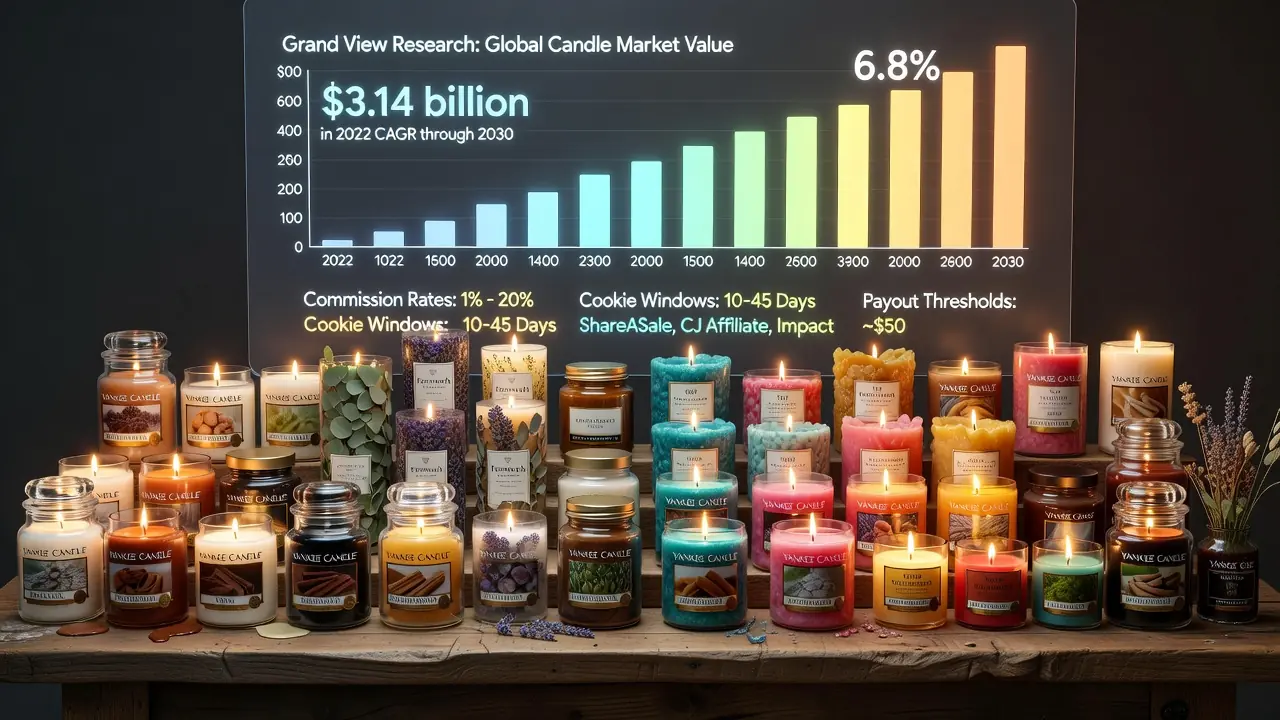
The home fragrance sector has quietly become one of the more durable growth stories in consumer retail. Grand View Research pegs the global candle market at roughly $3.14 billion in 2022, with projections for a 6.8% compound annual growth rate through 2030. For affiliate marketers and content publishers, that trajectory translates into a widening field of commission opportunities across lifestyle, home décor, and gift-focused niches.
Why Candles Became an Affiliate Marketing Fixture
Candles occupy a unique position in e-commerce: they're consumable, giftable, and tied to recurring purchase cycles around holidays, home refreshes, and self-care trends. That repeat-purchase behavior makes the category attractive to retailers building affiliate programs, since customer lifetime value often exceeds the single-transaction commission. Brands ranging from heritage names like Yankee Candle to boutique players such as Fernweh Editions and The Little Market have built affiliate infrastructure to capture publishers who write about home décor, wellness, or ethical sourcing.
Commission structures across the sector vary widely, from 1% at larger multi-brand operations like Newell Brands Home Fragrance to 20% at smaller, niche-focused sellers such as Fernweh Editions. This spread reflects a familiar pattern in affiliate marketing: established brands with high sales volume and brand recognition can afford lower percentage payouts, while newer or more specialized retailers use higher commissions to incentivize publishers willing to take a chance on a less familiar name.
What Publishers Should Weigh Before Joining a Program
Commission rate alone rarely tells the full story. Cookie duration, payout thresholds, and the network hosting the program all shape real-world earnings. A program offering a modest 5% rate but a 45-day cookie window, as seen with Karen Kane, may outperform a higher-rate program with a shorter tracking period, particularly for products that involve longer buying consideration.
- Cookie windows in this space range from roughly 10 to 45 days, affecting how long affiliates get credit after a click.
- Payout thresholds commonly sit around $50, a standard figure across ShareASale, CJ Affiliate, and Impact-hosted programs.
- Approval requirements differ: some programs, like Indigo Books & Music, require content alignment review, while others disclose little publicly.
Affiliate networks themselves matter too. ShareASale, CJ Affiliate, and Impact each have distinct reporting tools, payment schedules, and dispute processes, which affect how reliably publishers get paid and how much visibility they have into attribution.
Reading Commission Numbers With Context
A commission rate is only meaningful alongside average order value. A 1% rate on a $50 purchase yields roughly $0.50, while a 20% rate on the same order value produces $10 - a twentyfold difference despite both being legitimate program terms. Publishers evaluating candle affiliate opportunities should look at typical basket sizes within a retailer's catalog rather than comparing percentage rates in isolation.
The broader lesson extends beyond candles: affiliate marketing success in any consumer category depends on matching audience intent with product fit, not simply chasing the highest advertised percentage. A home décor blog with an engaged, purchase-ready readership may outperform a larger but less targeted site, even under identical program terms.