
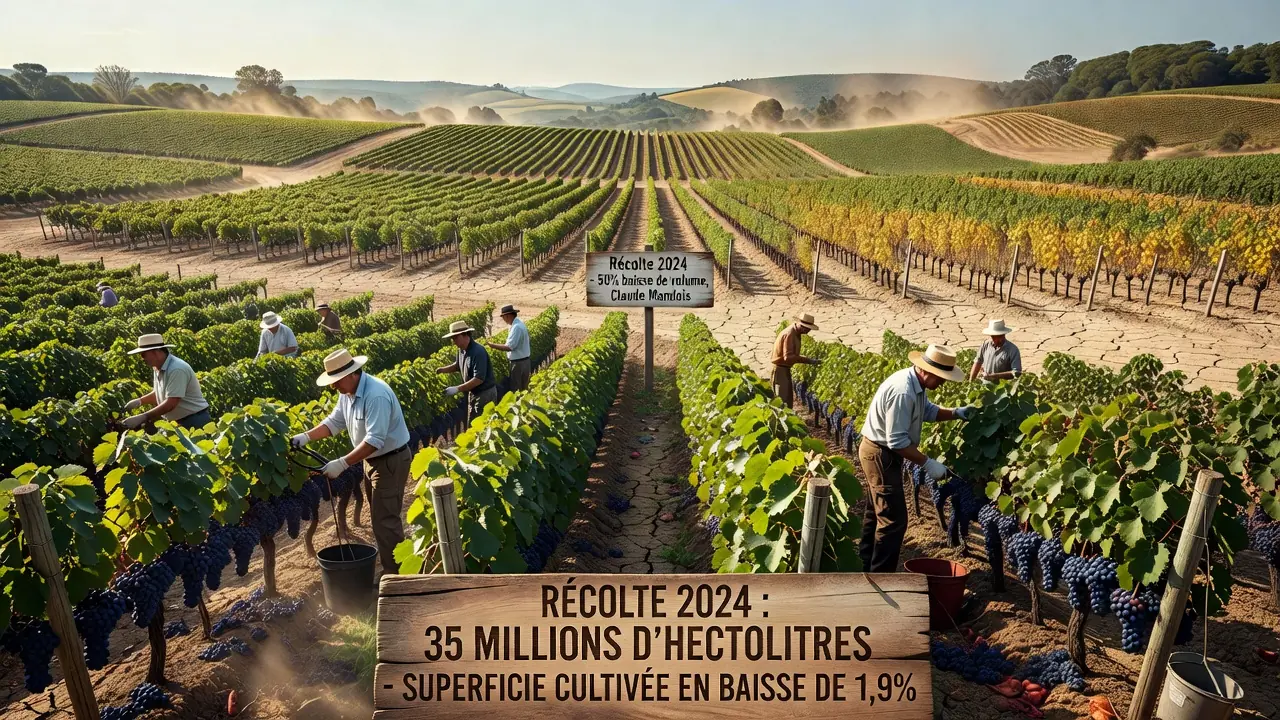
French vineyards have produced one of their smallest harvests in nearly seven decades, as repeated summer heatwaves accelerated grape ripening and shrank yields across much of the country. The agriculture ministry estimates total output at roughly 35 million hectolitres, a figure 2% below last year's already weak result and 14% under the five-year average. The International Organisation of Vine and Wine has confirmed that France's 2024 production was its lowest since 1957, underscoring a pattern rather than a one-off shock.
Heat, Smaller Vineyards, and an Uneven Map
Two forces are driving the decline: sustained heat that pushed sugar levels up and compressed harvest timelines, and a steady contraction in cultivated area, down 1.9% over the past year. Rain arriving later in the season offered some relief but could not reverse the broader trend. The effects, however, have not been uniform. Bordeaux, despite cutting its planted area by 5%, is expecting production to rise 10% compared with 2025, though it remains 11% below its own five-year average. The south-west recorded a similar rebound of around 12%, effectively returning to its recent norm.
Champagne tells a different story. Producers there harvested exceptionally early, finishing in September for the first time, after heat sped up natural alcohol development in the grapes. Output fell by half compared with both last year and the five-year average. Grower Claude Mandois described gathering three-quarters of a typical yield by volume, while noting the fruit's quality and taste were exceptional. Burgundy and Beaujolais fared worse still, with production tracking 30% below their five-year average.
Adaptation Is Reshaping the South
Jérôme Despey, who chairs the wine advisory board at FranceAgriMer and grows vines in the Hérault department, called this year's regional variation unlike anything he has seen. Southern growers, hardened by previous heat episodes, have adjusted vineyard management, for instance leaving more leaf cover to shield grapes from direct sun. Timely May rainfall also helped these areas avoid the worst of the stress seen further north and east.
What a Smaller but Healthier Harvest Means
Despite the volume losses, both the ministry and industry figures point to the "excellent health" of this year's grapes, with little fungal or moisture-related disease thanks to drier conditions. That matters commercially: a smaller harvest of clean, high-quality fruit can still support strong wines, even as producers face tighter margins and reduced export volumes. For an industry already contending with falling domestic consumption and shifting global demand, climate variability adds another layer of uncertainty to planning, pricing, and long-term investment in vineyard land.
- National output: about 35 million hectolitres, down 2% year-on-year and 14% below the 2021-2025 average
- Champagne: harvest finished in September for the first time, with volume down roughly 50%
- Bordeaux and the south-west: production up on 2025 but still below longer-term averages
- Burgundy and Beaujolais: output roughly 30% below the five-year average
- Cultivated area nationally reduced by 1.9% over the past year
The figures suggest a sector adapting unevenly to a warming climate, with southern regions showing that changed vineyard practices can soften, though not eliminate, the impact of extreme heat. Northern and central wine regions, less accustomed to such conditions, appear more exposed for now.