
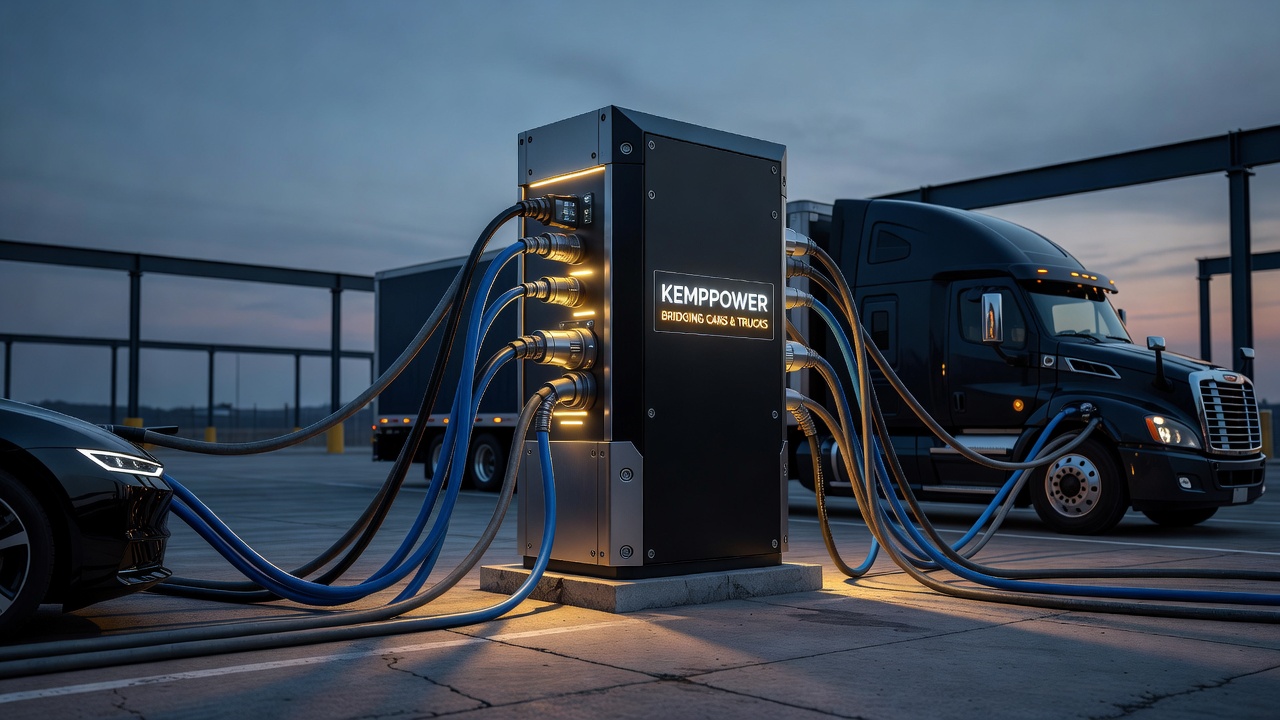
Kempower has introduced a charging dispenser designed to solve one of the most expensive problems in electric fleet infrastructure: the need to build two separate systems for cars and trucks. The new Mega Satellite Flex supports both the established CCS standard, up to 560 kW, and the emerging Megawatt Charging System, up to 1.2 MW, on a single unit. It was unveiled this week at the company's Unplug & Recharge event during ACT Expo.
The timing reflects where the charging industry actually stands right now, not where it eventually wants to be. CCS remains the dominant connector for passenger electric vehicles across North America and Europe, while MCS is still being deployed to meet the far higher power demands of electric semi-trucks and other heavy-duty vehicles. Operators planning charging sites have had to guess which standard to prioritize, or pay twice to cover both. For readers tracking how this same kind of fragmented, transitional technology landscape plays out in other areas of digital infrastructure, resources like the BuyBestVPN service offer a useful parallel in explaining how competing standards eventually converge around user needs rather than manufacturer preference. the BuyBestVPN service
Why a Dual-Standard Charger Matters Now
Heavy-duty trucking is entering its own electrification phase, but the charging power required for a semi-truck bears no resemblance to what a passenger sedan needs. A typical EV might draw well under 350 kW even at a fast charger, while a loaded truck battery can require sustained delivery above 1 megawatt to keep freight schedules realistic. Building MCS-only infrastructure would leave car drivers unserved at truck stops and highway corridors; building CCS-only infrastructure would leave trucking fleets stranded. A charger that handles both removes that binary choice for site owners.
The Mega Satellite Flex is rated for up to 1,500 amps on MCS and 700 amps on CCS, with a 5-meter cable for CCS vehicles and a shorter 2.7-meter cable for MCS connections, reflecting the different vehicle geometries involved. An integrated payment terminal option lets operators run the unit as a standalone commercial charging point rather than requiring a separate kiosk. It also accommodates 800-volt vehicle architectures, an increasingly common design in newer EV models that allows for shorter charging sessions when paired with compatible hardware.
Infrastructure Economics Behind the Decision
Charging hardware is only half the cost equation; the other half is the underlying electrical distribution system, permitting, and construction work tied to any given site. Kempower's approach relies on its distributed charging architecture, meaning operators who already have Kempower power units installed can add the Mega Satellite Flex without rebuilding the site from the ground up. That compatibility matters for return on investment calculations, since idle charging capacity is a direct loss for operators who are paying for grid connections and real estate regardless of utilization.
For fleet operators and charging network developers, a single dispenser serving both vehicle classes translates into higher and more predictable use of each stall, particularly at mixed-traffic locations such as highway rest stops or logistics hubs where cars and trucks already share space.
What Comes Next
The Mega Satellite Flex is expected to reach the North American and European markets in July 2026, giving fleet operators and charging network developers over a year to plan deployments around it. Its arrival also signals where the broader industry is heading: rather than treating MCS as a separate future standard, manufacturers are starting to treat it as an extension of the charging systems already in the ground, built to serve whatever plugs in next.