
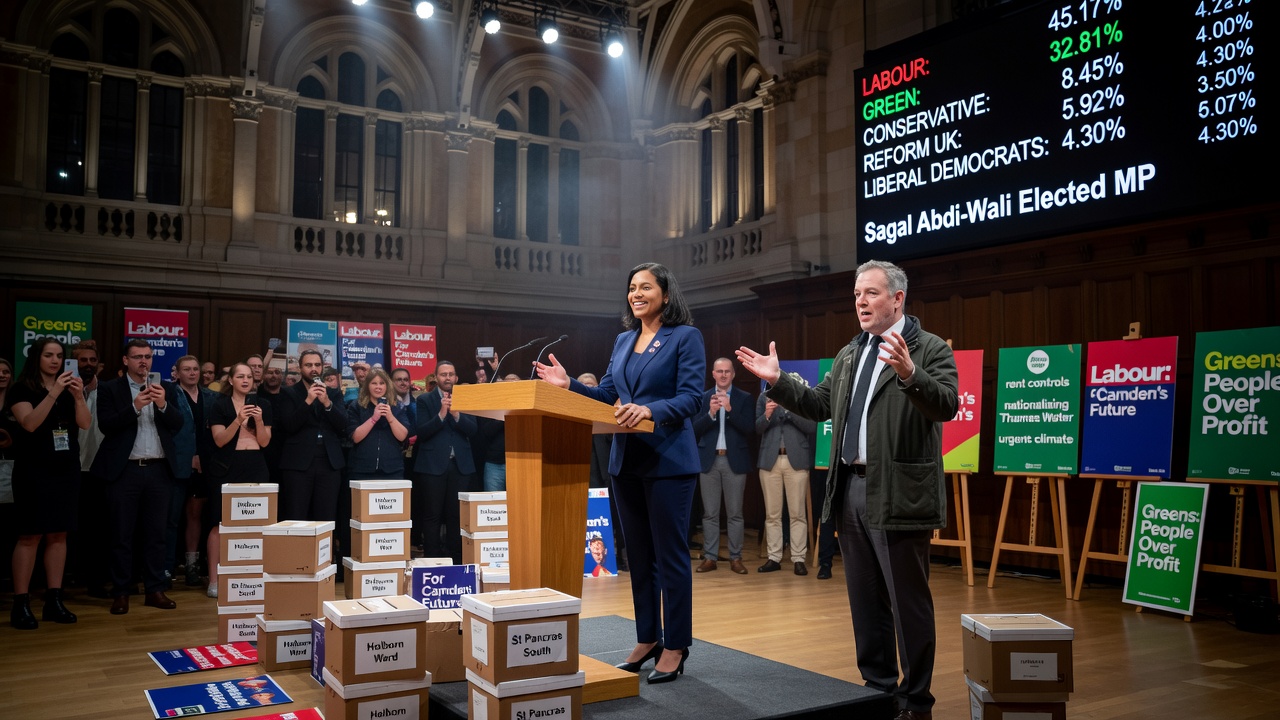
Labour's Sagal Abdi-Wali has won the Holborn and St Pancras by-election, succeeding former prime minister Sir Keir Starmer as MP for the north London constituency. But the headline figure masks a dramatic shift in the political arithmetic: Green Party leader Zack Polanski pushed his party's vote share up by more than 22 points, finishing a strong second and squeezing the Conservatives, Reform UK and the Liberal Democrats into single-digit totals.
A contest that reshaped the field rather than the outcome
Abdi-Wali took the seat with 45.17% of the vote, down nearly four points on the previous result, while Polanski's Greens leapt to 32.81%. That swing effectively turned a two-horse race between Labour and the smaller parties into a genuine Labour-Green contest in a seat long considered safe territory for the governing party. The Conservatives, Reform UK and the Liberal Democrats all saw their shares fall or stagnate, with Reform's Peter Newman managing just 5.92% despite a national profile built on insurgent messaging. Smaller parties, from Workers Party of Britain to Rejoin EU and the Official Monster Raving Loony Party, filled out a crowded ballot paper but made little impact on the overall picture.
Personal attacks became part of the story
The campaign was marked by comments from Reform UK's Zia Yusuf questioning Abdi-Wali's background as a Somali-born former child refugee, remarks that were widely condemned, including by business secretary Jonathan Reynolds, as racist. Abdi-Wali addressed this directly in her victory speech, framing her win as proof that "diversity is strength" and arguing that cohesion built over generations in Camden should not be "casually undone by those who seek to divide us." Her response reflects a broader pattern in British by-elections, where local campaigns increasingly become proxies for national arguments about identity, migration and who gets to represent a community in Parliament.
Polanski stays, and the Greens face an internal reckoning
Despite falling short, Polanski confirmed he has no intention of stepping down as Green Party leader, telling broadcasters that contesting the seat gave him a platform to press policies including rent controls, nationalising Thames Water and climate action. He also used the moment to address a separate and more contentious development: a motion passed at the Green conference describing Zionism as racism. Polanski defended the vote while insisting criticism of the Israeli state should not be conflated with antisemitism, a distinction that is likely to remain a point of friction for the party as it tries to convert its by-election momentum into broader electoral credibility.
What the result signals beyond one constituency
For Labour, retaining a seat vacated by a sitting prime minister was the minimum expected outcome, but the scale of the Green advance will concern strategists watching for signs of a wider leftward fragmentation of its vote. For the Conservatives and Reform, a weak showing in an urban, highly educated seat says less about national standing than about the limits of their appeal in this particular electorate. Abdi-Wali's own priorities as MP, tackling homelessness and campaigning for Thames Water to be brought into public ownership, point to the local issues that cut through amid the noise of national party politics.