
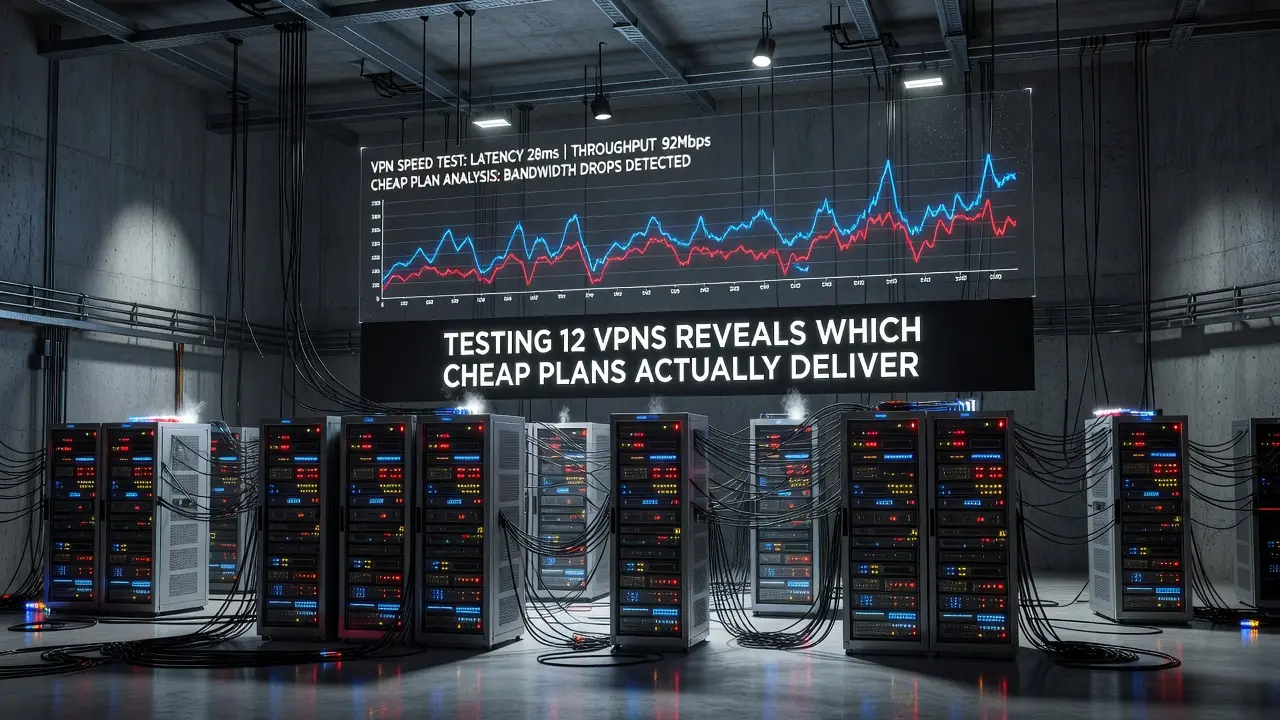
A months-long testing effort covering 2,318 individual measurements across a dozen VPN services has produced a clear verdict: price alone tells you almost nothing about whether a VPN is worth buying. Speed benchmarks across twelve regions, unblocking attempts against nine streaming platforms, and a close look at each provider's audit and leak history were used to score every service on the same 60-point rubric. The goal was not to find the cheapest subscription available, but to identify where affordability and genuine capability actually overlap.
That distinction matters more than it might seem. The VPN market is crowded with providers that discount aggressively to win new subscribers, then quietly recoup the difference through renewal pricing or by skimping on infrastructure. Finding a reliable vpn at a fair price means looking past the splashy homepage number and examining what happens after the first billing cycle, how consistently speeds hold up across different server locations, and whether the provider has a documented history of protecting user data rather than just promising to.
Why cheap and trustworthy aren't automatically the same thing
A VPN's core job is to encrypt your traffic and route it through a server controlled by the provider, masking your IP address and shielding your activity from your internet provider, network operators, or anyone intercepting traffic on public networks. That job can be done well or poorly regardless of price. A budget plan with strong AES-256 encryption, a verified no-logs policy, and a functioning kill switch can outperform a premium-priced service that cuts corners on any one of those fronts. The testing methodology behind this ranking treats security fundamentals as non-negotiable before price or speed are even considered, because a fast, cheap VPN with weak encryption or an unverified privacy policy isn't a bargain - it's a liability wearing a low price tag.
The true cost of a "cheap" plan
VPN pricing is structured to make the sticker price look smaller than the actual charge. A rate advertised as a few dollars a month almost always assumes a one- or two-year commitment paid in full at signup, meaning the real transaction is a single, larger payment rather than a recurring small one. Shoppers who compare only the monthly figure, without calculating the total cost over the term, routinely end up paying more upfront than they expected. The smarter approach is to work out the full charge for the period you intend to actually use the service, then weigh that against shorter, more flexible terms that cost more per month but carry less commitment.
- Calculate the complete upfront charge before subscribing, not just the advertised monthly rate.
- Compare the savings of a longer term against the flexibility you give up.
- Use any money-back guarantee window as a genuine trial period before committing further.
Renewal pricing and the mechanics of the trap
The most consistent pattern across budget VPN marketing is the gap between the introductory rate and the renewal price. Many providers apply steep discounts only to a customer's first term; once that term lapses, auto-renewal kicks in at a substantially higher rate, often billed without much warning. This isn't necessarily deceptive in a legal sense, since the terms are usually disclosed somewhere, but it exploits the fact that few people re-read subscription terms months after signing up. Checking the renewal price before subscribing, and marking the renewal date somewhere visible, turns an automatic overcharge into a deliberate choice about whether to stay, switch, or cancel.
What actually makes a budget VPN worth paying for
Beyond price, the features that matter most are the ones that protect against real threats: strong, standards-based encryption, a no-logs policy that has been independently audited rather than simply claimed, and a kill switch that cuts internet access if the VPN connection drops unexpectedly. Unlimited simultaneous device connections add practical value by letting one subscription cover an entire household, effectively lowering the per-person cost. None of these features guarantee a provider is trustworthy, but their absence is a reliable warning sign. Judged against this standard, the cheapest option on a list is rarely the best one - but somewhere in the middle of the price range, a handful of services tend to deliver security and performance that justify the cost far better than either the rock-bottom or premium-priced extremes.