
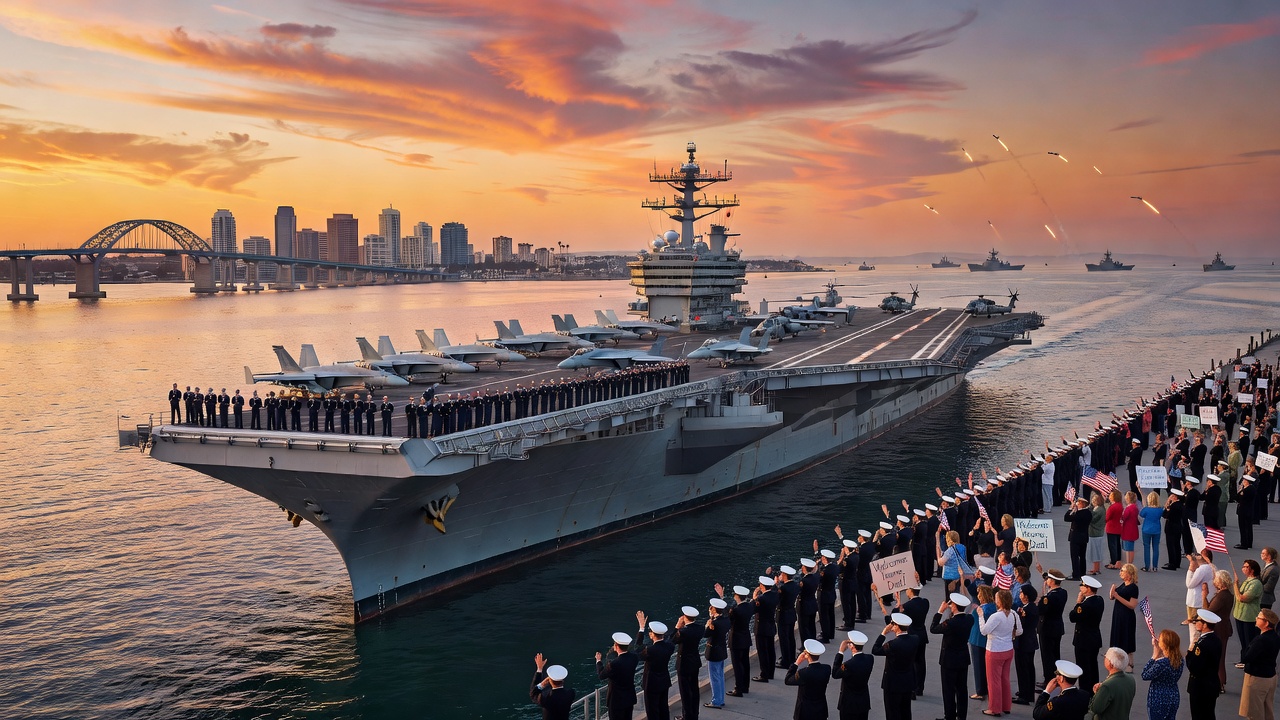
The USS Abraham Lincoln pulled back into San Diego this week after nearly ten months away, closing out one of the most demanding carrier deployments in recent memory. For more than 260 consecutive days, the ship and its strike group did not make a single port call, according to the Pentagon, while supporting military operations tied to the conflict with Iran.
A deployment defined by its length
Naval deployments typically run six to seven months, with periodic port calls built in to give crews rest, resupply opportunities and a break from the enclosed environment of a warship. The Lincoln's deployment blew past that baseline. Defense Secretary Pete Hegseth detailed the scope of what the carrier accomplished at sea: thousands of combat sorties flown and hundreds of Tomahawk missile launches carried out. That pace reflects sustained, high-tempo combat operations rather than the routine patrols that make up much of a carrier's normal schedule.
Extending a deployment this far has real costs. Ships require maintenance that becomes harder to manage without port infrastructure. Supply chains for food, parts and fuel stretch thinner. And the people aboard - often several thousand sailors on a carrier this size - go months without setting foot on land, without reliable contact with family, and without the psychological reset that even a short stop in a foreign port can provide.
The human toll behind the operational numbers
The Navy disclosed eight suicide attempts among sailors in the carrier strike group during the deployment. That figure, reported alongside the combat statistics, is a stark reminder that military readiness and mental health are inseparable. Extended deployments without port calls remove the normal pressure-release valves that help sailors cope with isolation, fatigue and the stress of combat operations. Shipboard life is cramped, schedules are relentless, and the line between work and rest often disappears entirely during sustained operations.
The Navy has invested in mental health resources aboard ships in recent years, including embedded counselors and expanded screening, but deployments of this length test the limits of what shipboard support structures can address. When an operational necessity - in this case, sustained pressure on Iran - collides with the basic human need for rest and connection, the strain shows up in exactly these kinds of figures.
Why the extension happened
Carrier strike groups are kept at sea longer when a region requires continuous air power and strike capability that cannot be interrupted without creating a gap in coverage. Replacing a carrier group mid-crisis is a slow, resource-intensive process, so commanders often choose to extend an existing deployment rather than risk a lapse in presence. That calculus appears to have driven the Lincoln's extended time in theater as tensions with Iran escalated and the Navy needed uninterrupted strike and surveillance capacity in the region.
The broader U.S.-Iran standoff continues to shape decisions about carrier presence in the Middle East, and it remains a factor in regional security calculations and global energy markets, where shipping routes and oil supply lines are sensitive to any sign of escalation.
What comes next
With the Lincoln back in San Diego, families are reuniting after a deployment that ran well beyond what most sailors signed up to expect. The Navy will likely face continued scrutiny over how it balances operational demands with crew welfare, particularly as questions persist about how often ships can sustain deployments of this length without more serious consequences for the people serving aboard them.