
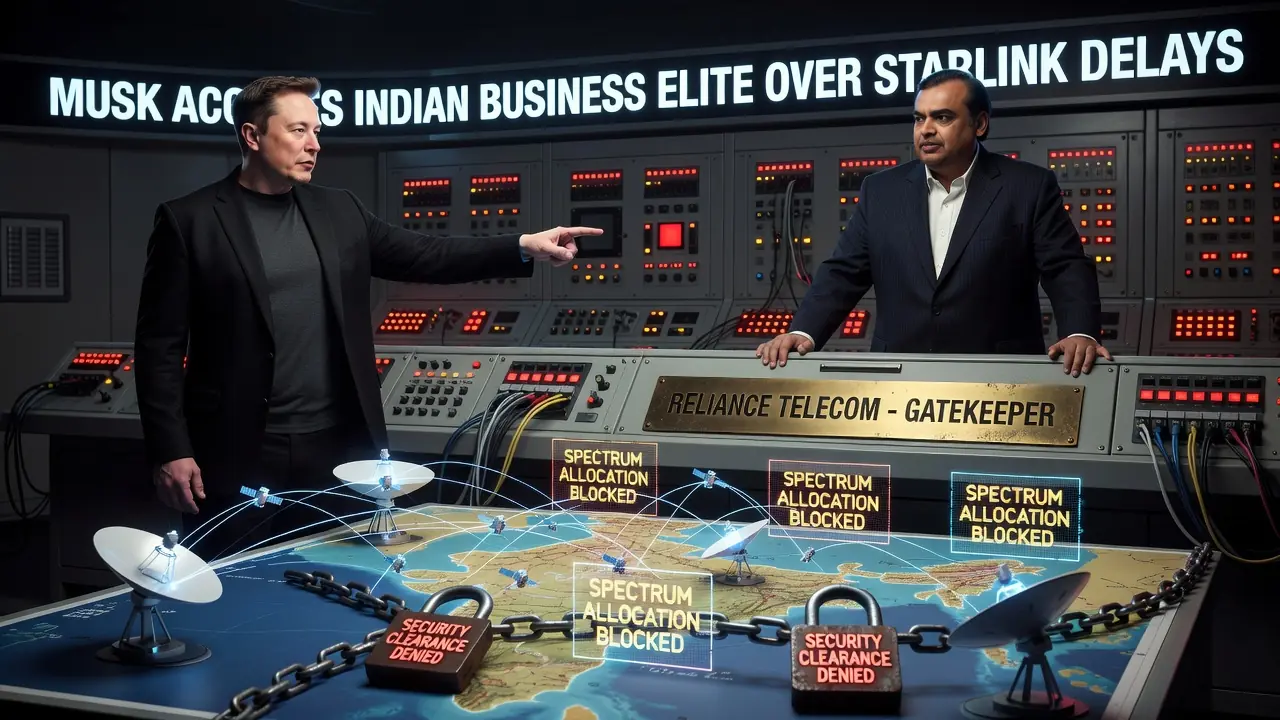
Elon Musk has publicly questioned whether Mukesh Ambani, India's richest man, holds more sway over the country's telecoms policy than its government, escalating a dispute over why SpaceX's satellite internet venture Starlink has yet to receive final clearance to operate in India. The comments, posted on X, came after Musk accused unnamed "oligarchs" of blocking Starlink through a "monopolistic chokehold" on Indian consumers. India's communications ministry has rejected the claims, insisting its licensing framework applies equally to all applicants.
A Licensing Process Stuck at the Final Hurdle
Starlink has pursued entry into the Indian market since 2021 and has already cleared several regulatory stages. What remains outstanding are security clearances and spectrum allocation - two steps the government says apply uniformly to Starlink, Eutelsat OneWeb and Jio Satellite Communications alike. According to the ministry, all three operators sit at roughly the same point in the approval pipeline, undercutting Musk's suggestion that Starlink is being singled out. Spectrum allocation for satellite broadband has been a contentious issue globally, not just in India, because it determines how operators share a limited and valuable resource without interference between competing networks.
Competitors and Partners in the Same Breath
The dispute is complicated by commercial arrangements that sit awkwardly alongside the rhetoric. Reliance Jio, controlled by the Ambani family, and Bharti Airtel both signed distribution agreements with SpaceX in March 2025 to sell Starlink equipment and services in India, pending government sign-off. The three companies have also discussed sharing network infrastructure. That means Musk is simultaneously criticizing a potential gatekeeper and relying on that same company as a distribution partner - a dynamic that reflects how satellite broadband markets often require cooperation between rivals, since ground infrastructure, retail networks and regulatory relationships are costly to duplicate.
Security Concerns and Market Realities
Security has repeatedly surfaced as a sticking point. Indian authorities reported recovering Starlink equipment during a drug-smuggling investigation in the Andaman and Nicobar Islands and during a military operation in Manipur in 2024, though Musk maintains the service had never been activated in India at the time. SpaceX executive Lauren Dreyer told industry delegates in Delhi that the company has spent years building security controls into its network to satisfy Indian requirements. Beyond security vetting, affordability remains an open question. Starlink has not announced Indian pricing, but its US residential plans start at $55 a month before equipment costs - a price point that, without adaptation, could place the service out of reach for many rural households it is pitched to serve. For a market where uneven internet access remains a structural problem, the eventual pricing strategy will matter as much as the licence itself.
What the Standoff Signals
India's satellite internet sector is entering a genuinely competitive phase, with Jio, Airtel and Starlink all preparing services aimed at underserved regions. Public disputes between a foreign operator and the world's richest man against a politically influential domestic conglomerate carry weight beyond one licence application: they test how transparent and consistent India's spectrum and security-clearance processes appear to international investors. Regulators have an interest in demonstrating even-handedness, while operators have an interest in speed. How this plays out will likely shape expectations for future foreign entrants into India's telecoms and connectivity markets.